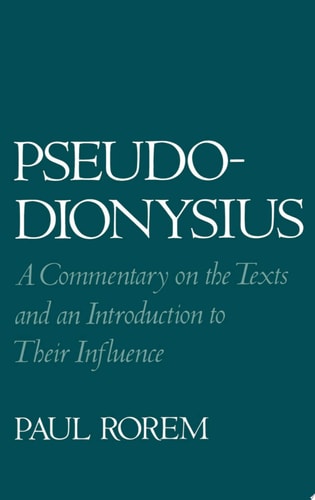
Pseudo-Dionysius: A Commentary on the Texts and an Introduction to Their Influence
Author Description
"Dionysius the Areopagite" is the biblical name chosen by the pseudonymous author of an influential body of Christian theological texts, dating from around 500 C.E. The Celestial Hierarchy, The Ecclesiastical Hierarchy, The Divine Names, and The Mystical Theology offer a synthesis of biblical interpretation, liturgical spirituality, and Neoplatonic philosophy. Their central motif, which has made them the charter of Christian mysticism, is the upward progress of the soul toward God through the spiritual interpretation of the Bible and the liturgy. Dionysius continually reminds his readers, however, that all human concepts fall short of the transcendence of God and must therefore be abandoned in negotiations and silence. In this book, Rorem provides a commentary on all of the Dionysian writings, chapter by chapter, and examines especially their complex inner coherence. The Dionysian influence on medieval theology is introduced in essays on specific topics: hierarchy, biblical symbolism, angels, Gothic architecture, liturgical allegory, the scholastic doctrine of God, and the mystical theology of the western Middle Ages. Rorem's book makes these texts more accessible to both scholars and students and includes a comprehensive bibliography of secondary sources.
Menrva's Summary
THE THESIS
This work investigates the theological framework and historical influence of the pseudonymous author known as Pseudo-Dionysius the Areopagite. Paul Rorem, a scholar of medieval theology, analyzes the corpus of texts dating to approximately 500 C.E. to clarify their synthesis of Neoplatonic philosophy and Christian liturgical practice. By providing a chapter-by-chapter commentary, Rorem argues that these writings possess a coherent internal logic centered on the soul's ascent toward divine transcendence through silence and symbolic interpretation.
THE SCOPE MAP
What You Will Find
- Detailed chapter-by-chapter commentary on The Celestial Hierarchy, The Ecclesiastical Hierarchy, The Divine Names, and The Mystical Theology.
- Analysis of the intersection between Neoplatonic philosophy and early Christian liturgical spirituality.
- Examination of the historical impact of Dionysian thought on medieval concepts such as hierarchy, angels, and Gothic architecture.
- A comprehensive bibliography of secondary sources for further academic research.
THE AUTHORITY PERSPECTIVE
Scholars frequently identify this text as a primary resource for navigating the complex, often dense theological arguments found in the Dionysian corpus. It is widely regarded as a foundational introduction that successfully bridges the gap between specialized academic study and student accessibility.
Page Count:
288
Publication Date:
1993-02-25
Publisher:
Oxford University Press
ISBN-10:
0195076648
ISBN-13:
9780195076646
History
Philosophy
Christianity
Theology
Mysticism
Community Tags
Similar Books