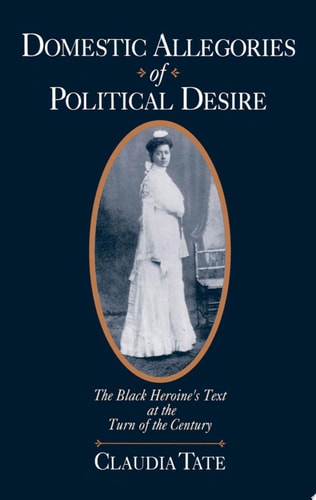
Domestic Allegories of Political Desire: The Black Heroine's Text at the Turn of the Century
0
0
As an Amazon Associate and affiliate partner, Menrva Books earns from qualifying purchases. Learn more
Author Description
Why did African-American women novelists use idealized stories of bourgeois courtship and marriage to mount arguments on social reform during the last decade of the nineteenth century, during a time when resurgent racism conditioned the lives of all black Americans? Such stories now seem like apolitical fantasies to contemporary readers. This is the question at the center of Tate's examination of the novels of Pauline Hopkins, Emma Kelley, Amelia Johnson, Katherine Tillman, and Frances Harper. Domestic Allegories of Political Desire is more than a literary study; it is also a social and intellectual history--a cultural critique of a period that historian Rayford W. Logan called "the Dark Ages of recent American history." Against a rich contextual framework, extending from abolitionist protest to the Black Aesthetic, Tate argues that the idealized marriage plot in these novels does not merely depict the heroine's happiness and economic prosperity. More importantly, that plot encodes a resonant cultural narrative--a domestic allegory--about the political ambitions of an emancipated people. Once this domestic allegory of political desire is unmasked in these novels, it can be seen as a significant discourse of the post-Reconstruction era for representing African-Americans' collective dreams about freedom and for reconstructing those contested dreams into consummations of civil liberty.
Menrva's Summary
THE THESIS
This book investigates why African-American women novelists at the turn of the nineteenth century utilized the conventions of bourgeois courtship and marriage to articulate complex arguments regarding social reform and political agency. Claudia Tate, a scholar of African-American literature, examines the works of authors such as Pauline Hopkins, Emma Kelley, and Frances Harper against the backdrop of the post-Reconstruction era. She argues that these domestic narratives function as allegories for the broader collective aspirations of Black Americans, transforming the marriage plot into a vehicle for demanding civil liberty and social recognition during a period of intense racial oppression.
THE SCOPE MAP
What You Will Find
- Analysis of novels by Pauline Hopkins, Emma Kelley, Amelia Johnson, Katherine Tillman, and Frances Harper.
- A cultural critique of the post-Reconstruction era, often referred to as the Dark Ages of American history.
- Examination of the intersection between domestic fiction and political discourse.
- A contextual framework spanning from abolitionist protest to the development of the Black Aesthetic.
THE AUTHORITY PERSPECTIVE
Scholars and critics frequently cite this work as a foundational text for understanding the political dimensions of nineteenth-century African-American women's fiction. Readers often note the academic density of the prose, which provides a rigorous intellectual history of the period.
Page Count:
312
Publication Date:
1993-01-07
Publisher:
Oxford University Press
ISBN-10:
0195073894
ISBN-13:
9780195073898
History
Literary Criticism
Authors fiction
American
Allegory
Heroines
Community Tags
Similar Books