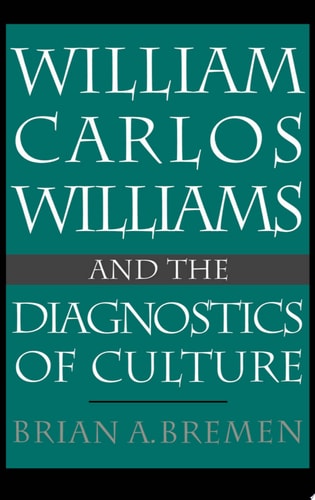
William Carlos Williams and the Diagnostics of Culture
0
0
As an Amazon Associate and affiliate partner, Menrva Books earns from qualifying purchases. Learn more
Author Description
Bremen's study examines the development of William Carlos Williams's poetics, focusing in particular on Williams's ongoing fascination with the effects of poetry and prose, and his life-long friendship with Kenneth Burke. Using a framework based on Burke's and Williams's theoretical writings and correspondence, as well as on the work of contemporary cultural critics, Bremen looks closely at how Williams's poetic strategies are intimately tied to his medical practice, incorporating a form of methodological empiricism that extends his diagnoses beyond the individual to include both language and community. The book develops a series of rhetorical, cognitive, medical, and political analogues that clarify the poetic and cultural achievements Williams hoped to realize in his writing.
Menrva's Summary
THE THESIS
This study investigates how William Carlos Williams integrated his medical practice with his poetic methodology to diagnose the cultural and linguistic health of his society. Brian Bremen utilizes a framework rooted in the theoretical writings and personal correspondence of Williams and his lifelong friend, Kenneth Burke. By synthesizing these primary sources with contemporary cultural criticism, the author argues that Williams’s work functions as a diagnostic tool that extends beyond the individual patient to address the broader community and the structure of language itself.
THE SCOPE MAP
What You Will Find
- Analysis of the intersection between medical empiricism and poetic strategy
- Examination of the intellectual relationship between William Carlos Williams and Kenneth Burke
- Application of rhetorical, cognitive, and political analogues to Williams's body of work
- Exploration of how poetic form serves as a diagnostic instrument for cultural critique
THE AUTHORITY PERSPECTIVE
Scholars frequently cite this work as a significant contribution to understanding the intersection of Williams's professional medical life and his literary output. The text is noted for its rigorous application of Burkean theory to the development of modern American poetics.
Page Count:
248
Publication Date:
1993-04-29
Publisher:
Oxford University Press
ISBN-10:
019507226X
ISBN-13:
9780195072266
Poetry
Biography
Literary Criticism
American
Community Tags
Similar Books