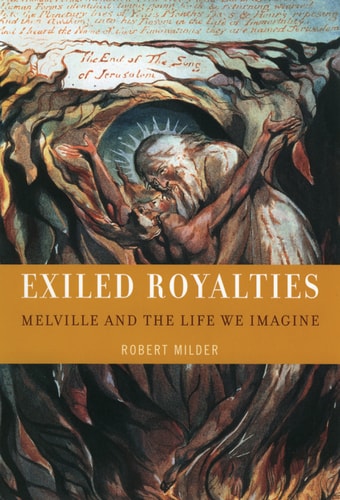
Exiled Royalties: Melville and the Life We Imagine
0
0
As an Amazon Associate and affiliate partner, Menrva Books earns from qualifying purchases. Learn more
Author Description
Exiled Royalties is a literary/biographical study of the course of Melville's career from his experience in Polynesia through his retirement from the New York Custom House and his composition of three late volumes of poetry and Billy Budd, Sailor. Conceived separately but narratively and thematically intertwined, the ten essays in the book are rooted in a belief that "Melville's work," as Charles Olson said, "must be left in his own 'life,'" which for Milder means primarily his spiritual, psychological, and vocational life. Four of the ten essays deal with Melville's life and work after his novelistic career ended with the The Confidence-Man in 1857. The range of issues addressed in the essays includes Melville's attitudes toward society, history, and politics, from broad ideas about democracy and the course of Western civilization to responses to particular events like the Astor Place Riots and the Civil War; his feeling about sexuality and, throughout the book, about religion; his relationship to past and present writers, especially to the phases of Euro-American Romanticism, post-Romanticism, and nascent Modernism; his relationship to his wife, Lizzie, to Hawthorne, and to his father, all of whom figured in the crisis that made for Pierre. The title essay, "Exiled Royalties," takes its origin from Ishmael's account of "the larger, darker, deeper part of Ahab"--Melville's mythic projection of a "larger, darker, deeper part" of himself. How to live nobly in spiritual exile--to be godlike in the perceptible absence of God--was a lifelong preoccupation for Melville, who, in lieu of positive belief, transposed the drama of his spiritual life to literature. The ways in which this impulse expressed itself through Melville's forty-five year career, interweaving itself with his personal life and the life of the nation and shaping both the matter and manner of his work, is the unifying subject of Exiled Royalties.
Menrva's Summary
THE THESIS
How does the intersection of Herman Melville's personal spiritual crises and his professional trajectory shape the thematic evolution of his literary output? Robert Milder, a scholar of American literature, utilizes a biographical and critical framework to argue that Melville’s work cannot be separated from his internal psychological and vocational life. By examining the entirety of Melville's career—from his early Polynesian experiences to his final years of poetry and prose—Milder posits that the author’s writing served as a primary vehicle for navigating his spiritual exile and existential questions.
THE SCOPE MAP
What You Will Find
- Analysis of Melville's post-1857 career, including his late poetry and Billy Budd, Sailor.
- Examination of Melville's interpersonal relationships with figures such as Nathaniel Hawthorne and his wife, Lizzie.
- Discussion of Melville's engagement with historical events like the Astor Place Riots and the American Civil War.
- Exploration of Melville's shifting attitudes toward religion, sexuality, and democratic ideals.
Scope Limits
- The text does not provide a comprehensive chronological biography, focusing instead on thematic essays.
- It does not offer a broad survey of 19th-century American literature outside of its direct relevance to Melville's development.
THE AUTHORITY PERSPECTIVE
Scholars frequently cite this work as a nuanced contribution to Melville studies, particularly for its focus on the author's later, less-studied years. Readers often note the academic density of the prose, which assumes a high level of familiarity with Melville's primary texts.
Page Count:
310
Publication Date:
2006-01-01
Publisher:
Oxford University Press
ISBN-10:
0190286539
ISBN-13:
9780190286538
Non-Fiction
Biography
Literary Criticism
English
Authors biography
Literary History
American
Authors American
English & College Success
Community Tags
Similar Books