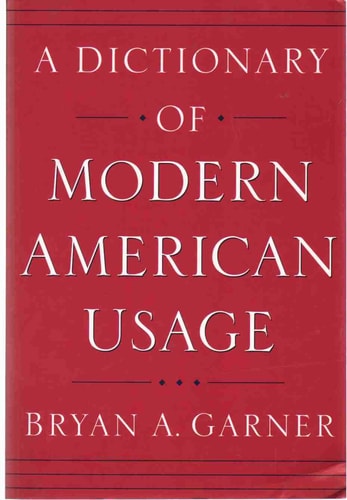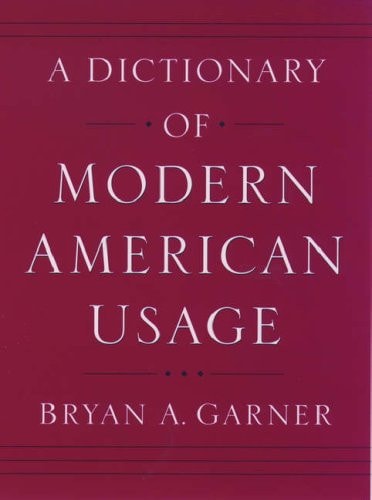
A Dictionary of Modern American Usage
0
0
As an Amazon Associate and affiliate partner, Menrva Books earns from qualifying purchases. Learn more
Author Description
In every age, writers and editors need guidance through the thickets of English usage. Although some language issues are perennial (infer vs. imply), many others spring anew from the well of English:* Is it all right to say alums instead of alumni or alumnae? And should it be spelled alums or alumns?* Should I say empathic or empathetic? Do you home in or hone in? Is it a couple of dozen or a couple dozen?* What's the singular of paparazzi? Is paparazzis an acceptable plural? What about graffiti--singular or plural? And what about kudos?* What's the correct pronunciation of concierge? Or schism? Or flaccid?This book will tell you. In 750 pages of crisp, precise, and often witty pronouncements on modern American English, Bryan Garner authoritatively answers these and thousands of other questions that bedevil those who care about the language. Garner draws on massive evidence to support his judgments, citing more than 5,000 examples--good, bad, and ugly--from sources such as The New York Times, The Wall Street Journal, and Newsweek.Here is a usage guide that, whether you're a language connoisseur or just a dabbler, you can savor in a leisurely way, a few paragraphs at a time. No one can browse through the book without sharing the author's spirited awareness of how words work and his relish for exposing the affectations that bloat our language. Yet if you don't have the time for browsing, but simply want a quick answer to an editorial riddle, this book is your best bet.DMAU can justifiably lay claim to being the most comprehensive treatment of how American English is used--and abused--as we enter the 21st century.
Menrva's Summary
THE THESIS
This work investigates the evolving standards of American English usage to provide clear, authoritative guidance for writers and editors navigating complex linguistic choices. Bryan A. Garner, a noted legal scholar and lexicographer, utilizes a massive corpus of contemporary media examples to analyze common grammatical pitfalls, stylistic inconsistencies, and evolving vocabulary. The book functions as a comprehensive reference tool, balancing prescriptive rules with descriptive observations of how the language is actually employed in professional journalism and literature.
THE SCOPE MAP
What You Will Find
- Analysis of over 5,000 examples of usage drawn from major publications like The New York Times and The Wall Street Journal.
- Detailed entries on perennial linguistic debates such as word choice, spelling, and pluralization.
- Pronunciation guides for frequently mispronounced or ambiguous terms.
- A systematic framework for identifying and correcting stylistic affectations that impede clarity.
THE AUTHORITY PERSPECTIVE
Experts and linguists frequently cite this text as a foundational resource for professional editors and serious writers due to its rigorous data-driven approach. Readers often note that the prose is accessible and witty, making it suitable for both quick reference and extended study.
Page Count:
752
Publication Date:
1998-12-03
Publisher:
Oxford University Press
ISBN-10:
0195078535
ISBN-13:
9780195078534
Non-Fiction
Reference
Education
Writing
Language
Americanisms