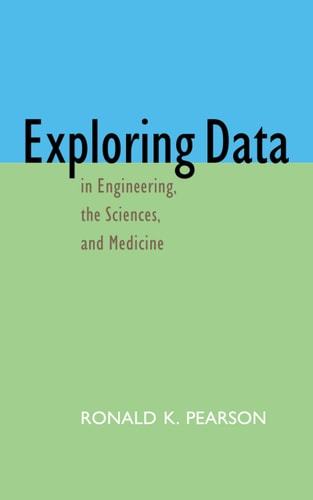
Exploring Data in Engineering, the Sciences, and Medicine
0
0
As an Amazon Associate and affiliate partner, Menrva Books earns from qualifying purchases. Learn more
Author Description
The recent dramatic rise in the number of public datasets available free from the Internet, coupled with the evolution of the Open Source software movement, which makes powerful analysis packages like R freely available, have greatly increased both the range of opportunities for exploratory data analysis and the variety of tools that support this type of analysis.This book will provide a thorough introduction to a useful subset of these analysis tools, illustrating what they are, what they do, and when and how they fail. Specific topics covered include descriptive characterizations like summary statistics (mean, median, standard deviation, MAD scale estimate), graphical techniques like boxplots and nonparametric density estimates, various forms of regression modeling (standard linear regression models, logistic regression, and highly robust techniques like least trimmed squares), and the recognition and treatment of important data anomalies like outliers and missing data. The unique combination of topics presented in this book separate it from any other book of its kind.Intended for use as an introductory textbook for an exploratory data analysis course or as self-study companion for professionals and graduate students, this book assumes familiarity with calculus and linear algebra, though no previous exposure to probability or statistics is required. Both simulation-based and real data examples are included, as are end-of-chapter exercises and both R code and datasets.
Menrva's Summary
THE THESIS
This book investigates the practical application of exploratory data analysis (EDA) tools to address the challenges posed by the increasing availability of public datasets and open-source software. Author Ronald K. Pearson leverages his expertise to provide a structured introduction to statistical analysis, focusing on the utility and limitations of various computational methods. By integrating theoretical concepts with R-based implementation, the text establishes a framework for identifying data anomalies and performing robust statistical modeling in scientific and engineering contexts.
THE SCOPE MAP
What You Will Find
- Descriptive characterizations including mean, median, standard deviation, and MAD scale estimates.
- Graphical analysis techniques such as boxplots and nonparametric density estimation.
- Regression modeling methodologies ranging from standard linear models to robust least trimmed squares.
- Practical strategies for the identification and treatment of outliers and missing data points.
THE AUTHORITY PERSPECTIVE
Experts identify this text as a highly practical resource for graduate students and professionals seeking to bridge the gap between theoretical statistics and applied data analysis. Readers frequently note the accessibility of the R-based examples, which facilitate a hands-on approach to mastering complex data manipulation techniques.
Page Count:
770
Publication Date:
2011-01-21
Publisher:
Oxford University Press
ISBN-10:
0195089650
ISBN-13:
9780195089653
Mathematics
Engineering
Computer Science
Statistics
Data Science
Reference
Community Tags
Similar Books