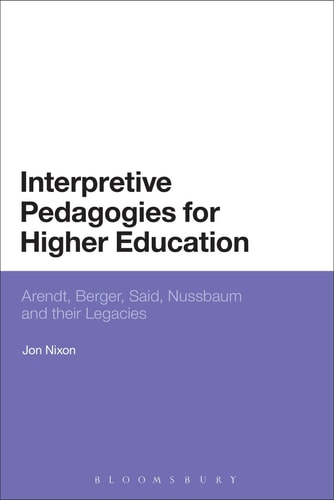
Interpretive Pedagogies for Higher Education: Arendt, Berger, Said, Nussbaum and their Legacies
0
0
As an Amazon Associate and affiliate partner, Menrva Books earns from qualifying purchases. Learn more
Author Description
Interpretive Pedagogies for Higher Education focuses on providing a humanistic perspective on pedagogy by relating it to the interpretive practices of particular public educators: thinkers and writers whose work has had an immeasurable impact on how we understand and interpret the world and how our understandings and interpretations act on that world. Jon Nixon focuses on the work of four public intellectuals each of whom reaches out to a wide public readership and develops our understanding regarding the nature of interpretation in the everyday world: Hannah Arendt's work on 'representative thinking', John Berger's injunction to 'hold everything dear', Edward Said's notion of 'democratic criticism', and Martha Nussbaum's studies in the intelligence of feeling. These thinkers provide valuable perspectives on the nature and purpose of interpretation in everyday life. The implications of these perspectives for the development of a transformative pedagogy - and for the renewal of an educated public - are examined in relation to the current contexts of higher education within a knowledge society.
Menrva's Summary
THE THESIS
This book investigates how the interpretive practices of influential public intellectuals can inform a humanistic approach to pedagogy in higher education. Jon Nixon examines the work of Hannah Arendt, John Berger, Edward Said, and Martha Nussbaum, focusing on their contributions to understanding interpretation in everyday life. The text explores concepts such as 'representative thinking,' 'hold everything dear,' 'democratic criticism,' and the 'intelligence of feeling.' Nixon then applies these insights to develop a transformative pedagogy for higher education within the context of a knowledge society, aiming to foster an educated public.
THE SCOPE MAP
- Analysis of Hannah Arendt's concept of 'representative thinking'.
- Exploration of John Berger's injunction to 'hold everything dear'.
- Examination of Edward Said's notion of 'democratic criticism'.
- Discussion of Martha Nussbaum's studies on the 'intelligence of feeling'.
- Connection of these interpretive practices to the development of a transformative pedagogy.
- Consideration of the renewal of an educated public.
- Application of these ideas to the current context of higher education in a knowledge society.
THE AUTHORITY PERSPECTIVE
The book is positioned as a scholarly exploration of pedagogical theory, drawing on the legacies of prominent public intellectuals. Its focus on humanistic perspectives and interpretive practices suggests an academic audience interested in the philosophical underpinnings of education. The work likely appeals to educators, literary critics, and students of philosophy and cultural studies seeking to understand how critical thought can shape teaching and learning. The examination of thinkers like Arendt, Berger, Said, and Nussbaum indicates a depth of engagement with complex theoretical frameworks.
Page Count:
192
Publication Date:
2014-01-02
Publisher:
Bloomsbury Academic
ISBN-10:
147252327X
ISBN-13:
9781472523273
Philosophy
Non-Fiction
Literary Fiction
Pedagogy
Higher Education
Literary Criticism