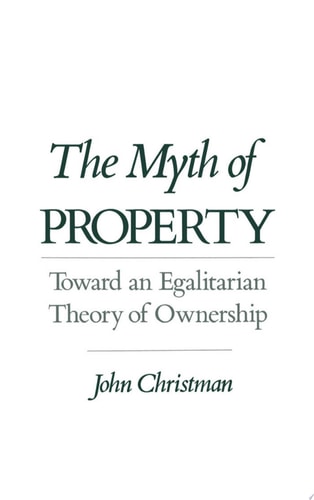
The Myth of Property: Toward an Egalitarian Theory of Ownership
0
0
As an Amazon Associate and affiliate partner, Menrva Books earns from qualifying purchases. Learn more
Author Description
The Myth of Property is the first book-length study to focus directly on the variable and complex structure of ownership. It critically analyzes what it means to own something, and it takes familiar debates about distributive justice and recasts them into discussions of the structure of ownership. The traditional notion of private property assumed by both defenders and opponents of that system is criticized and exposed as a "myth." The book then puts forward a new theory of what it means to own something, one that will be important for any theory of distributive justice. This new approach more adequately reveals the disparate social and individual values that property ownership serves to promote. The study has importance for understanding the reform of capitalist and welfare state systems, as well as the institution of market economies in former socialist states, for the view developed here makes the traditional dichotomy between private ownership capitalism and public ownership socialism obsolete. This new approach to ownership also places egalitarian principles of distributive justice in a new light and challenges critics to clarify aspects of property ownership worth protecting against calls for greater equality. The book closes by showing how defenders of egalitarianism can make use of some of the ideas and values that traditionally made private property appear to be such a pervasive human institution.
Menrva's Summary
THE THESIS
This work investigates the conceptual validity of private property by challenging the traditional, monolithic understanding of ownership as a singular, absolute right. John Philip Christman, a scholar of political and legal philosophy, utilizes analytical frameworks to deconstruct the conventional dichotomy between capitalist private ownership and socialist public ownership. By arguing that property is a bundle of distinct, variable rights rather than an indivisible entity, he proposes a new egalitarian theory of ownership that aligns with modern distributive justice requirements.
THE SCOPE MAP
What You Will Find
- A critical analysis of the traditional, unitary concept of private property.
- A theoretical framework for decomposing ownership into a complex structure of variable rights.
- An examination of the intersection between property rights and distributive justice principles.
- A comparative evaluation of capitalist and welfare state systems in the context of market reform.
THE AUTHORITY PERSPECTIVE
Scholars and students of political philosophy frequently cite this text for its rigorous attempt to move beyond the binary debate of capitalism versus socialism. Readers often note the academic density of the prose, which serves as a foundational resource for those analyzing the structural components of property rights.
Page Count:
240
Publication Date:
1994-07-14
Publisher:
Oxford University Press
ISBN-10:
0195085949
ISBN-13:
9780195085945
Economics
Philosophy
Property
Political Philosophy
Social Theory
Community Tags
Similar Books