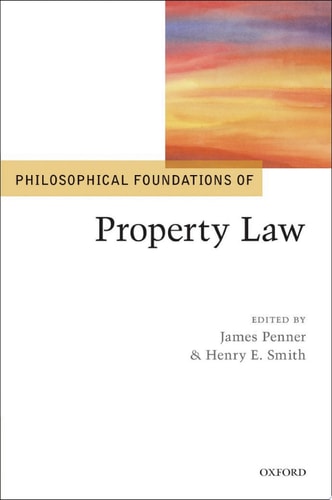
Philosophical Foundations of Property Law
0
0
As an Amazon Associate and affiliate partner, Menrva Books earns from qualifying purchases. Learn more
Author Description
Property has long played a central role in political and moral philosophy. Philosophers dealing with property have tended to follow the consensus that property has no special content but is a protean construct - a mere placeholder for theories aimed at questions of distributive justice and efficiency. Until recently there has been a relative absence of serious philosophical attention paid to the various doctrines that shape the actual law of property. If the philosophy of property is to be more attentive to concepts lying between broad considerations of political philosophy and distributive justice on the one hand and individual rules on the other, what in this broad space needs explaining, and how might we justify what we find? The papers in this volume are a first step towards filling this gap in the philosophical analysis of private law. This is achieved here by revisiting the contributions of philosophers such as Hume, Locke, Kant, and Grotius and revealing how particular doctrines illuminate the way in which property law respects the equality and autonomy of its subjects. Secondly, by exploring the central notions of possession, ownership, and title and finally by considering the very foundations of conceptualism in property.
Menrva's Summary
THE THESIS
This volume investigates the philosophical underpinnings of property law to determine how specific legal doctrines align with broader moral and political frameworks. The authors, Henry Smith and James Penner, curate a collection of scholarly papers that bridge the gap between abstract distributive justice and the practical application of property rules. By examining historical and contemporary perspectives, the text argues that property law functions as a coherent system that respects individual autonomy and equality.
THE SCOPE MAP
What You Will Find
- Analysis of classical philosophical contributions from Hume, Locke, Kant, and Grotius.
- Examination of core legal concepts including possession, ownership, and title.
- Theoretical exploration of conceptualism within property law frameworks.
Scope Limits
- The text does not provide a comprehensive manual for practicing property law in specific jurisdictions.
- It avoids exhaustive coverage of modern statutory variations across different international legal systems.
THE AUTHORITY PERSPECTIVE
Legal scholars and students of jurisprudence frequently cite this work as a significant contribution to the philosophical study of private law. Experts highlight the text for its ability to synthesize complex historical theory with the practical realities of property doctrine.
Page Count:
395
Publication Date:
2013-01-01
Publisher:
OUP Oxford
ISBN-10:
0191654531
ISBN-13:
9780191654534
Philosophy
Property
Professional Career & Trade
Jurisprudence
Property Law
Legal Theory
Law
Political Philosophy
Community Tags
Other Editions(3)

Similar Books