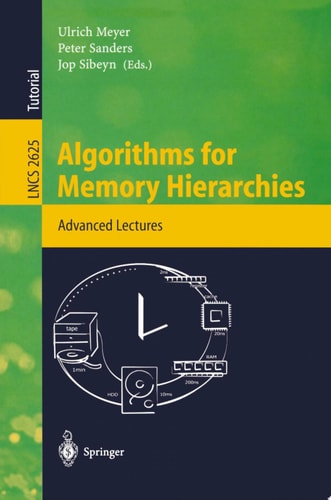
Algorithms for Memory Hierarchies
0
0
As an Amazon Associate and affiliate partner, Menrva Books earns from qualifying purchases. Learn more
Author Description
Algorithms that have to process large data sets have to take into account that the cost of memory access depends on where the data is stored. Traditional algorithm design is based on the von Neumann model where accesses to memory have uniform cost. Actual machines increasingly deviate from this model: while waiting for memory access, nowadays, microprocessors can in principle execute 1000 additions of registers; for hard disk access this factor can reach six orders of magnitude. The 16 coherent chapters in this monograph-like tutorial book introduce and survey algorithmic techniques used to achieve high performance on memory hierarchies; emphasis is placed on methods interesting from a theoretical as well as important from a practical point of view.
Menrva's Summary
THE THESIS
This book investigates the design and analysis of algorithms that optimize performance in the face of modern memory hierarchies. The authors address the growing disparity between processor speed and memory access times, a deviation from the traditional von Neumann model. The monograph-like tutorial introduces and surveys algorithmic techniques that are both theoretically interesting and practically important for achieving high performance on current hardware architectures.
THE SCOPE MAP
- Algorithmic techniques for memory hierarchies
- Analysis of algorithms considering memory access costs
- Methods for achieving high performance on modern computer architectures
- Theoretical and practical considerations for algorithm design
- Survey of existing research and techniques in the field
THE AUTHORITY PERSPECTIVE
This monograph-like tutorial is designed to introduce and survey algorithmic techniques crucial for high performance on memory hierarchies. It emphasizes methods that are both theoretically significant and practically relevant, catering to researchers and practitioners in computer science. The book's focus on the practical implications of memory access costs in algorithm design suggests it is a valuable resource for understanding contemporary computer architecture challenges.
Page Count:
429
Publication Date:
2003-07-01
Publisher:
Springer Nature
ISBN-10:
3540365745
ISBN-13:
9783540365747
Non-Fiction
Science
Computer Architecture
Computer Science
Algorithms
Community Tags
Similar Books