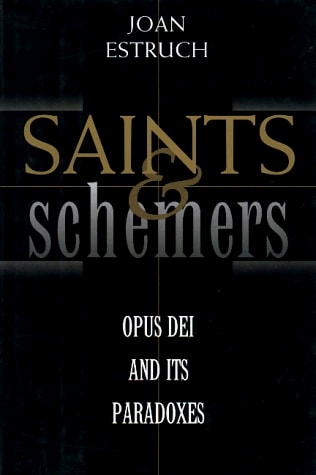
Saints and Schemers: Opus Dei and Its Paradoxes
0
0
As an Amazon Associate and affiliate partner, Menrva Books earns from qualifying purchases. Learn more
Author Description
The Roman Catholic organization known as Opus Dei seems to attract either virulent criticism or extravagant praise. It has been attacked as a "secret society," an "ecclesiastical mafia," and a cult that promotes bizarre ascetic practices, enslaves its members by mind-control techniques, and intimidates detractors through personal attacks and character assassination. But it has many powerful allies, especially in the Vatican. Indeed, Pope John Paul II is a staunch supporter of Opus ("The Work") and of its founder, the late Monsignor Escriva' de Balaguer, whose controversial beatification attracted 200,000 followers to St. Peter's Square in 1992.Drawing on dozens of interviews with members and former members--including priests, educators, doctors, Jesuits, and insiders connected with the Vatican Curia--and mining Opus Dei's own literature for clues, Joan Estruch provides the first authoritative portrait of this elusive organization. He begins with a fascinating look at the founder of Opus Dei, uncovering much information not found in the official biographies of Escriva'. He examines, for instance, the question of Escriva''s many name changes, his initially negative reaction to Vatican II (a reaction Opus now denies), his fondness for aristocratic refinements and honors, and his petition to become a member of the nobility. The founder of Opus Dei emerges as a complex, enigmatic figure, ambitious and impulsive, but also a man of extraordinary sincerity. Estruch also sheds much light on the origin and evolution of this influential and controversial movement. He reveals that, contrary to the official version, Opus Dei was not founded in 1928, but in 1939 and its birth was closely linked with the establishment of Franco's regime. And he also points out that the Jesuits--the arch-enemies of Opus Dei--were actually the model that initially inspired Escriva'. If their relations have been marked by confrontation and conflict, Estruch contends, it is due to their similarities.
Menrva's Summary
THE THESIS
This book investigates the historical origins, internal power structures, and sociopolitical paradoxes of the Roman Catholic organization Opus Dei. Joan Estruch, a sociologist, utilizes a combination of primary source analysis, internal literature, and extensive interviews with both current and former members to deconstruct the organization's public image. The text argues that the movement's history is more complex and politically entangled than official narratives suggest, particularly regarding its relationship with the Franco regime and the Vatican.
THE SCOPE MAP
What You Will Find
- Historical analysis of the founding of Opus Dei and its links to mid-20th-century Spanish politics.
- Biographical examination of the founder, Monsignor Escrivá de Balaguer, including his personal ambitions and contradictions.
- Comparative study of the institutional rivalry between Opus Dei and the Jesuits.
- Qualitative data derived from interviews with insiders, clergy, and former members.
THE AUTHORITY PERSPECTIVE
Experts recognize this work as a foundational sociological study that provides a necessary critical counterpoint to official institutional biographies. Readers frequently note the academic rigor and objective tone Estruch maintains while navigating highly polarized subject matter.
Page Count:
320
Publication Date:
1995-09-21
Publisher:
Oxford University Press
ISBN-10:
0195082516
ISBN-13:
9780195082517
Biography
Religion
History
Sociology
Catholicism
Religion and sociology
Spain religion
Community Tags
Similar Books