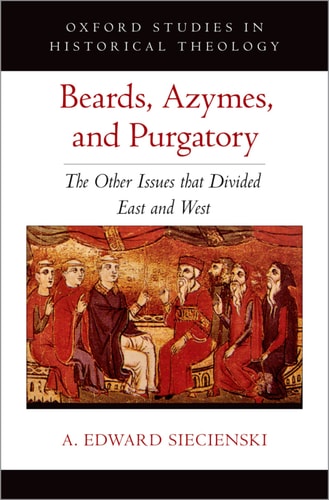
Beards, Azymes, and Purgatory: The Other Issues that Divided East and West
0
0
As an Amazon Associate and affiliate partner, Menrva Books earns from qualifying purchases. Learn more
Author Description
The Catholic and Orthodox churches have been divided for nearly a thousand years. The issues that divide them are weighty matters of theology, from a dispute over the Nicene Creed to the question of the authority of the Pope. But while these issues are cited as the most important reasons for the split, they were not necessarily the issues that caused it. In Beards, Azymes, and Purgatory A. Edward Siecienski argues that other, seemingly minor issues also played a significant role in the schism.Although rarely included in modern-day ecumenical dialogues, for centuries these "other issues"--the beardlessness of the Latin clergy, the Western use of unleavened bread in the Eucharist, and the doctrine of Purgatory--were among the most frequently cited reasons for the dispute between East and West. Disagreements about bread, beards, and the state of souls after death may not, at first, appear to be church-dividing issues, but they are the nevertheless among the reasons why the church today is divided. This was a schism over azymes long before it was a schism over the primacy of the Bishop of Rome, and the beardlessness of the Latin clergy was cited as a reason for breaking communion with the Latin Church prior to all the subsequent arguments about the wording of the Nicene Creed. To understand the schism between East and West, Siecienski contends, we must grasp not only the reasons it remains, but also the reasons it began.
Menrva's Summary
THE THESIS
This work investigates the historical significance of secondary theological and liturgical disputes in the Great Schism between the Eastern and Western churches. A. Edward Siecienski, a scholar of historical theology, utilizes primary source documents and historical records to argue that issues often dismissed as minor—specifically the use of unleavened bread, the practice of clerical shaving, and the doctrine of Purgatory—were foundational to the initial rupture between the churches. By re-examining these points of contention, the author demonstrates that these practices were central to the identity and communion debates of the medieval period, often preceding the more famous theological disagreements regarding papal authority and the Nicene Creed.
THE SCOPE MAP
What You Will Find
- Historical analysis of the liturgical use of azymes (unleavened bread) in the West.
- Examination of the cultural and theological significance of clerical beards in the East-West divide.
- Investigation into the development and reception of the doctrine of Purgatory.
- Contextualization of these issues within the broader timeline of the Great Schism.
Scope Limits
- The text does not provide an exhaustive history of the entire Great Schism.
- It does not focus on modern ecumenical reconciliation efforts beyond identifying the historical roots of the division.
THE AUTHORITY PERSPECTIVE
Scholars and historians recognize this text as a specialized contribution to the study of medieval church history, noting its ability to clarify how seemingly trivial practices carried profound theological weight. Readers frequently highlight the academic rigor of the prose and the author's success in shifting the focus from high-level dogmatic disputes to the lived realities of medieval religious practice.
Page Count:
336
Publication Date:
2022-01-01
Publisher:
Oxford University Press
ISBN-10:
0190065087
ISBN-13:
9780190065089
History
Soft Sci-fi
Church History
Social Sciences - Religion - Christianity
Catholicism
Theology
Church Leadership
New Used & Rental Textbooks
General
Ecumenism
Ecclesiastical History
Christianity
Community Tags
Similar Books