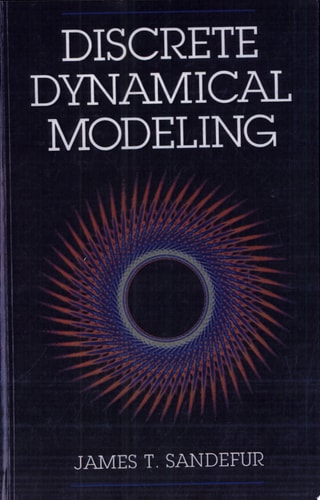
Discrete Dynamical Modeling
0
0
As an Amazon Associate and affiliate partner, Menrva Books earns from qualifying purchases. Learn more
Author Description
This book presents an introduction to the wide range of techniques and applications for dynamic mathematical modeling that are useful in studying systemic change over time. The author expertly explains how the key to studying change is to determine a relationship between occurring events and events that transpire in the near future. Mathematical modeling of such cause-and-effect relationships can often lead to accurate predictions of events that occur farther in the future. Sandefur's approach uses many examples from algebra--such as factoring, exponentials and logarithms--and includes many interesting applications, such as amortization of loans, balances in savings accounts, growth of populations, optimal harvesting strategies, genetic selection and mutation, and economic models. This book will be invaluable to students seeking to apply dynamic modeling to any field in which change is observed, and will encourage them to develop a different way of thinking about the world of mathematics.
Menrva's Summary
THE THESIS
This book investigates the methodology of discrete dynamical modeling as a primary tool for predicting systemic change over time. James T. Sandefur, an experienced educator in the field, provides a structured framework for identifying cause-and-effect relationships within evolving systems. By utilizing algebraic principles, the author demonstrates how current events can be mathematically linked to future outcomes to generate accurate long-term projections.
THE SCOPE MAP
What You Will Find
- Algebraic techniques including factoring, exponentials, and logarithms
- Applications in financial modeling such as loan amortization and savings account balances
- Biological and ecological models covering population growth and genetic mutation
- Economic strategies regarding optimal harvesting and resource management
THE AUTHORITY PERSPECTIVE
Experts recognize this text as a practical introduction for students transitioning from basic algebra to applied mathematical modeling. Readers frequently note the clarity of the examples provided, which bridge the gap between abstract theory and real-world systemic analysis.
Page Count:
448
Publication Date:
1993-07-15
Publisher:
Oxford University Press
ISBN-10:
0195084381
ISBN-13:
9780195084382
Algebra
Applied Mathematics
Mathematics
Calculus
Modeling
Community Tags
Similar Books