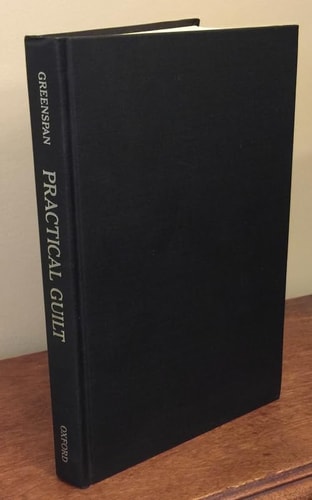
Practical Guilt: Moral Dilemmas, Emotions, and Social Norms
0
0
As an Amazon Associate and affiliate partner, Menrva Books earns from qualifying purchases. Learn more
Author Description
P.S. Greenspan uses the treatment of moral dilemmas as the basis for an alternative view of the structure of ethics and its relation to human psychology. Greenspan argues that dilemmas may be regarded as possible consequences of a set of social rules designed to be simple enough to be teachable. Where these rules prohibit action either way, the problematic motivational force of dilemmas can be explained by reference to the role of emotion as a substitute for action. Guilt is seen as a natural but contested candidate for the sort of emotional sanction for wrongdoing that might supply motivational force in dilemmas. It functions as a way of preserving virtue against moral luck. Greenspan defends guilt in the face of dilemmas on the basis of a "nonjudgmentalist" account of emotions that accepts guilt as appropriate even in some cases of unavoidable wrongdoing. In its treatment of the role of emotion in ethics the argument of the book outlines a new way of packing motivational force into moral meaning that allows for a socially based version of moral realism. Since, on the proposed account, emotions underpin the teaching of moral language, human emotional capacities impose constraints on the nature of a viable moral code and thus affect the content of morality.
Menrva's Summary
THE THESIS
This book investigates whether moral dilemmas can be understood as inherent consequences of social rule systems that rely on emotional responses like guilt to provide motivational force. P. S. Greenspan, a philosopher specializing in ethics and emotion, utilizes a framework that bridges the gap between human psychology and normative ethics. She argues that because social rules must remain simple enough for instruction, they inevitably create situations where action is prohibited regardless of the choice made. By analyzing guilt as a nonjudgmental emotional sanction, the author proposes a version of moral realism that accounts for the constraints human emotional capacity places on the development of viable moral codes.
THE SCOPE MAP
What You Will Find
- An analysis of moral dilemmas as structural byproducts of simplified social rule sets.
- A nonjudgmentalist theory of emotions that validates guilt in cases of unavoidable wrongdoing.
- A philosophical argument linking human emotional capacity to the content and viability of moral codes.
- A defense of moral realism grounded in the social functions of emotional sanctions.
THE AUTHORITY PERSPECTIVE
Experts in moral philosophy recognize this text as a significant contribution to the study of emotion and ethics. Readers frequently note the academic density of the prose, which is intended for scholars and advanced students of philosophical ethics.
Page Count:
264
Publication Date:
1995-01-12
Publisher:
Oxford University Press
ISBN-10:
0195087623
ISBN-13:
9780195087628
Philosophy
Psychology
Ethics
Moral Philosophy
Guilt
Social Science
Community Tags
Similar Books