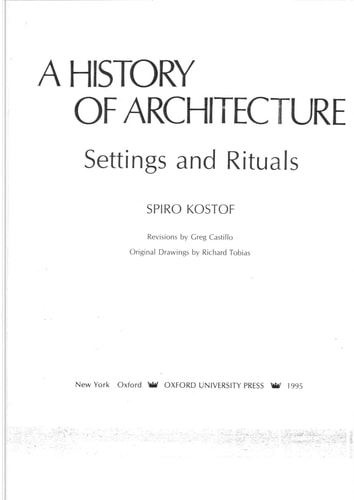
A History of Architecture: Settings and Rituals
0
0
As an Amazon Associate and affiliate partner, Menrva Books earns from qualifying purchases. Learn more
Author Description
When the late Spiro Kostof's A History of Architecture appeared in 1985, it was universally hailed as a masterpiece--one of the finest books on architecture ever written. The New York Times Book Review, in a front cover review, called it "a magnificent guided tour through mankind's architecture," and The San Francisco Chronicle wrote that "Kostof...has enthralled a generation of students.... Now he has done the same thing for the public at large, in an extraordinary book that is a new kind of architectural history."This magisterial work has now been revised and expanded by Greg Castillo, Kostof's colleague and literary executor. Insightful, engagingly written, and graced with almost a thousand superb illustrations, the Second Edition of this classic volume offers a sweeping narrative that examines architecture as it reflects the social, economic, and technological systems of human history. The scope of the book is astonishing. No mere survey of famous buildings, Kostof's History examines a surprisingly wide variety of manmade structures: prehistoric huts and the TVA, the pyramids at Giza and the Rome railway station, the ziggurat and the department store. Indeed, Kostof considered every building worthy of attention, every structure or shelter a potential source of insight, whether it be the prehistoric hunting camps at Terra Amata, or the caves at Lascaux with their magnificent paintings, or a twenty-story hotel on the Las Vegas strip. The Second Edition features a new concluding chapter, "Designing the Fin de Siècle," based on Kostof's last lecture notes and prepared by Castillo, as well as an all-new 16-page color section. Many of the original line drawings by Richard Tobias, as well as some 50 photographs, have also been updated or replaced, for improved clarity.Visually and intellectually stimulating, this book is at once a compelling history and an indispensable reference on all aspects of our built environment. It achieves for architecture what Janson's history of art did for the visual arts.
Menrva's Summary
THE THESIS
How do the built environments of human history reflect the social, economic, and technological systems of their respective eras? Spiro Kostof, a renowned architectural historian, argues that architecture is not merely a collection of aesthetic monuments but a comprehensive record of human activity and societal evolution. By examining structures ranging from prehistoric shelters to modern industrial complexes, the text provides a framework for understanding the built environment as a direct manifestation of human ritual and necessity.
THE SCOPE MAP
What You Will Find
- A chronological survey of global architectural development from prehistoric times to the late 20th century.
- Analysis of diverse structures including ziggurats, department stores, railway stations, and residential dwellings.
- Integration of social, economic, and technological contexts to explain architectural shifts.
- Extensive visual documentation including line drawings, photographs, and color plates to illustrate structural evolution.
THE AUTHORITY PERSPECTIVE
Experts and academics widely regard this volume as a foundational text for understanding the intersection of architecture and human history. Readers frequently note the accessibility of the prose despite the immense breadth of the subject matter, making it a standard reference for both students and the general public.
Page Count:
792
Publication Date:
1995-05-04
Publisher:
Oxford University Press
ISBN-10:
0195083784
ISBN-13:
9780195083781
Non-Fiction
Architecture
History
Architecture
urban planning
Design
Community Tags
Other Editions(2)

Similar Books











Reader Comments
Share Your Thoughts
No comments yet. Be the first to share your thoughts!