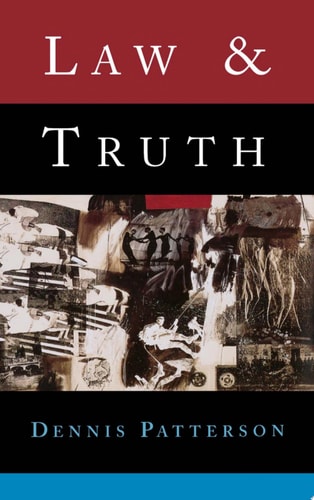
Law and Truth
0
0
As an Amazon Associate and affiliate partner, Menrva Books earns from qualifying purchases. Learn more
Author Description
Taking up a single question--"What does it mean to say a proposition of law is true?"--this book advances a major new account of truth in law. Drawing upon the later philosophy of Wittgenstein, as well as more recent postmodern theory of the relationship between language, meaning, and the world, Patterson examines leading contemporary jurisprudential approaches to this question and finds them flawed in similar and previously unnoticed ways. He offers a powerful alternative account of legal justification, one in which linguistic practice--the use of forms of legal argument--holds the key to legal meaning.
Menrva's Summary
THE THESIS
This book investigates the fundamental question of what it means to assert that a proposition of law is true. Dennis Patterson, a scholar of legal theory, utilizes the later philosophy of Ludwig Wittgenstein and postmodern linguistic theory to critique existing jurisprudential frameworks. He argues that current approaches to legal truth are fundamentally flawed and proposes an alternative model centered on linguistic practice and the application of legal arguments to establish meaning.
THE SCOPE MAP
What You Will Find
- An analysis of contemporary jurisprudential theories regarding legal truth.
- An application of Wittgensteinian philosophy to legal interpretation.
- A critique of the relationship between language, meaning, and legal reality.
- A proposed framework for legal justification based on the use of forms of legal argument.
THE AUTHORITY PERSPECTIVE
Legal scholars and philosophers frequently cite this work as a significant contribution to the intersection of analytical philosophy and jurisprudence. Readers often note the high level of academic density, making it a text primarily suited for those with a background in legal theory or philosophy of language.
Page Count:
200
Publication Date:
1996-04-25
Publisher:
Oxford University Press
ISBN-10:
0195083237
ISBN-13:
9780195083231
Non-Fiction
Philosophy
Jurisprudence
Legal Theory
Law
Law Philosophy
Truth
Community Tags
Similar Books