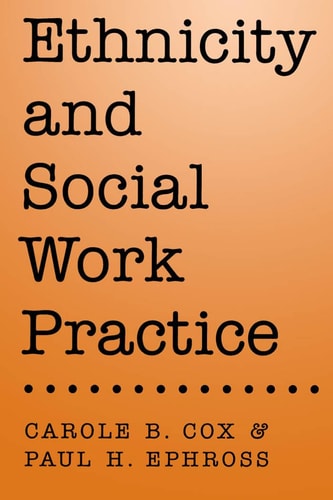
Ethnicity and Social Work Practice
0
0
As an Amazon Associate and affiliate partner, Menrva Books earns from qualifying purchases. Learn more
Author Description
Increasingly, social workers are working with clients from diverse backgrounds and cultures. Because ethnicity influences social workers in myriad ways, it is important for them to have a greater understanding of ethnicity and the ways in which it can influence individuals perceptions and responses to problems and treatment. Knowledge and understanding have therefore become critical for effective practice. However, knowledge is not the only factor necessary for establishing social work relationships with clients. To a large extent, the development of these relationships depends upon the sensitivity of the practitioner to the culture and traditions of the client, and the ways in which these may influence behaviors. Ethnicity and Social Work Practice fills a major gap in the literature on social work and ethnicity by offering a broad, conceptual model applicable to all ethnic populations. It presents ethnicity in an innovative way, focusing on its many dimensions as encountered in various areas of social work practice (individuals, families, groups, and communities) and includes separate chapters on social services, healthcare, and social planning and policy development. Rather than attempting to address these issues by describing the traits of specific ethnic groups, this text presents the model of an ethnic lens. It is through this lens that ethnic groups are likely to perceive society, problems, the helping process, and the social workers who assist them. At the same time, social work practitioners perceive various ethnic groups through their own lenses, based upon their own experiences and beliefs. The effectiveness of practice and the establishment of a valid social work relationship depends to a large extent on the clarity of these lenses.Ethnicity and Social Work Practice is careful to avoid the twin traps of stereotyping or ignoring the importance of ethnicity, presenting a comprehensive conceptual framework useful to both students and practitioners.
Menrva's Summary
THE THESIS
This text investigates how the concept of ethnicity functions as a critical lens through which both social workers and clients perceive the helping process and social reality. Authors Carole B. Cox and Paul H. Ephross provide a conceptual framework designed to move beyond the limitations of stereotyping specific ethnic groups. By focusing on the multidimensional nature of ethnicity, the authors argue that effective practice relies on the practitioner's ability to recognize and calibrate their own cultural lens alongside that of the client.
THE SCOPE MAP
What You Will Find
- A conceptual model of the ethnic lens applicable to diverse populations.
- Analysis of ethnicity across various practice levels including individuals, families, groups, and communities.
- Examination of ethnic influence within social services, healthcare, and policy development.
- Methodologies for establishing effective practitioner-client relationships without relying on cultural generalizations.
THE AUTHORITY PERSPECTIVE
Experts and educators recognize this text as a foundational resource for moving social work pedagogy away from static cultural trait lists toward a more dynamic, relational model. Practitioners frequently note that the framework provides a practical, non-reductive approach to navigating complex cross-cultural interactions in clinical and community settings.
Page Count:
192
Publication Date:
1997-08-28
Publisher:
Oxford University Press
ISBN-10:
0195099311
ISBN-13:
9780195099317
Ethnic Studies
Ethnic Groups
Introduction to Social WorkWelfare
Professional Development
Sociology
Social Work
Ethnicity
Education
Community Tags
Similar Books