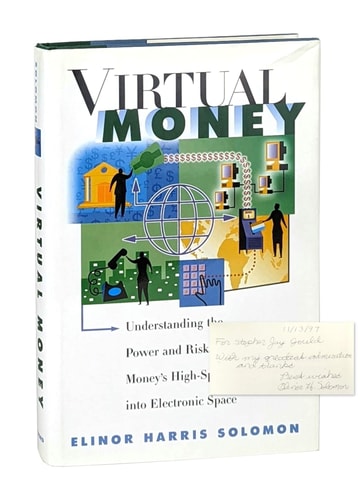
Virtual Money: Understanding the Power and Risks of Money's High-Speed Journey into Electronic Space
0
0
As an Amazon Associate and affiliate partner, Menrva Books earns from qualifying purchases. Learn more
Author Description
The amount of virtual money that circles the globe every day is truly staggering. The Federal Reserve's Fedwire and the New York-based CHIPS alone send out well over $2 trillion daily. Retail systems such as credit and debit cards deliver several hundred billion more. In fact, the combined dollar flow in one day equals over one-third of our gross domestic product for the entire year. Trillions of dollars of ethereal money soar around the globe, perched atop a very narrow "real" money base, and with the recent dramatic growth of the Internet, these vast numbers can only grow. In Virtual Money, the first book-length account of the electronic money phenomenon, economist Elinor Harris Solomon takes us on a fascinating tour of money's brave new world, offering an informative look at the pluses and minuses of virtual money in its myriad forms.Solomon provides a wide ranging introduction to electronic monies, describing in down-to-earth terms how each system works. Starting on familiar ground, with gold and paper money, she examines the growth of the credit card from the mid-sixties, when it was a status symbol for the wealthy, to its present nearly universal use throughout America, and she offers an engaging discussion of exotic new e-monies, such as "Smart Cards," e-cash, electronic wallets, and cybermoney, as well as upcoming innovations such as electronic benefits transfers (EBT), which may replace food stamps by 1999. Equally important, the book offers a clear picture of the advantages and disadvantages of electronic money. Clearly there are great benefits to consumers, investors, and corporations, as goods and services competing in world markets can be purchased instantly from anywhere across the globe. Yet there are hazards as well. For instance, the very size of virtual money movements creates an enormous float that exceeds the amount of monetary reserves to back it up at any given moment. Digital glitches can mean chaos, as in 1995 when a snafu that delayed the op
Menrva's Summary
THE THESIS
How does the rapid transition of global currency into electronic space alter the stability and functionality of modern financial systems? Economist Elinor Harris Solomon utilizes her extensive background in monetary policy to analyze the shift from physical tender to digital transactions. She examines the infrastructure of major clearing systems like Fedwire and CHIPS, arguing that while electronic money facilitates unprecedented global commerce, it simultaneously introduces systemic risks due to the disparity between digital volume and actual monetary reserves.
THE SCOPE MAP
What You Will Find
- Analysis of major electronic payment systems including Fedwire and CHIPS.
- Historical progression of credit and debit card adoption in the United States.
- Evaluation of emerging digital payment technologies like Smart Cards, e-cash, and electronic wallets.
- Assessment of the systemic hazards posed by digital glitches and the lack of sufficient monetary backing for high-speed electronic floats.
THE AUTHORITY PERSPECTIVE
Experts recognize this work as a foundational text for understanding the early evolution of digital finance and the structural implications of electronic money. Readers frequently note the clarity of the author's prose, which successfully translates complex monetary concepts into accessible information for a general audience.
Page Count:
304
Publication Date:
1997-10-30
Publisher:
Oxford University Press
ISBN-10:
0195097475
ISBN-13:
9780195097474
Economics
Business
Finance
Money
Technology
Community Tags
Similar Books





Reader Comments
Share Your Thoughts
No comments yet. Be the first to share your thoughts!