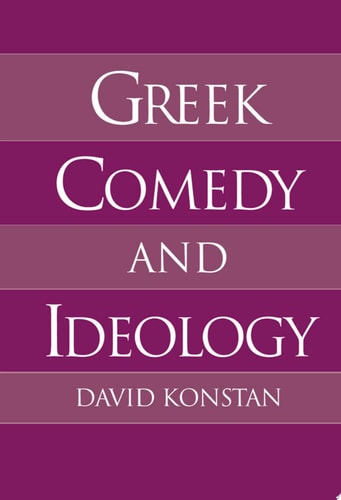
Greek Comedy and Ideology
0
0
As an Amazon Associate and affiliate partner, Menrva Books earns from qualifying purchases. Learn more
Author Description
In comedy, happy endings resolve real-world conflicts. These conflicts, in turn, leave their mark on the texts in the form of gaps in plot and inconsistencies of characterization. Greek Comedy and Ideology analyzes how the structure of ancient Greek comedy betrays and responds to cultural tensions in the society of the classical city-state. It explores the utopian vision of Aristophanes' comedies--for example, an all-powerful city inhabited by birds, or a world of limitless wealth presided over by the god of wealth himself--as interventions in the political issues of his time. David Konstan goes on to examine the more private world of Menandrean comedy (including two adaptations of Menander by the Roman playwright Terence), in which problems of social status, citizenship, and gender are negotiated by means of elaborately contrived plots. In conclusion, Konstan looks at an imitation of ancient comedy by Moliére, and the way in which the ideology of emerging capitalism transforms the premises of the classical genre.
Menrva's Summary
THE THESIS
This work investigates how the structural elements and narrative resolutions of ancient Greek comedy function as responses to the cultural and political tensions inherent in the classical city-state. David Konstan, a scholar of classical literature, utilizes a socio-historical framework to examine how playwrights like Aristophanes and Menander embedded contemporary ideological conflicts within their comedic plots. By analyzing the transition from the utopian political fantasies of Old Comedy to the private, status-oriented concerns of New Comedy, the author argues that these texts serve as active interventions in the social discourse of their respective eras.
THE SCOPE MAP
What You Will Find
- Analysis of utopian motifs in Aristophanes' plays as political commentary.
- Examination of social status, citizenship, and gender dynamics in Menandrean comedy.
- Comparative study of Roman adaptations by Terence.
- Evaluation of how Molière’s later imitations reflect the ideological shifts of emerging capitalism.
THE AUTHORITY PERSPECTIVE
Scholars frequently cite this text as a significant contribution to the study of the relationship between ancient drama and its socio-political environment. Readers often note the academic rigor of Konstan's analysis, which provides a foundational framework for understanding the ideological underpinnings of classical theater.
Page Count:
244
Publication Date:
1995-04-06
Publisher:
Oxford University Press
ISBN-10:
0195092945
ISBN-13:
9780195092943
Drama
History
English & College Success
English
Comedy
Literary Criticism
Greek drama
Community Tags
Similar Books