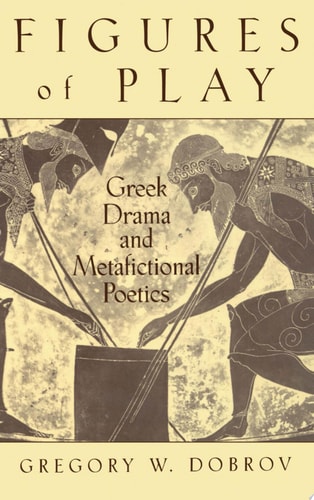
Figures of Play: Greek Drama and Metafictional Poetics
0
0
As an Amazon Associate and affiliate partner, Menrva Books earns from qualifying purchases. Learn more
Author Description
Figures of play explores the reflexive aspects of ancient theatrical culture across genres. Fifth century tragedy and comedy sublimated the agonistic basis of Greek civilization in a way that invited the community of the polis to confront itself. In the theatre, as in the courts and assemblies, a significant subset of the Athenian public was spectator and judge of contests where important social and ideological issues were played to it by its own members. The "syntax" of drama is shown to involve specific "figures of play" through which the theatrical medium turns back on itself to study the various contexts of its production. Greek tragedy and comedy were argued to be tempermentally metafictional in that they are always involved in recycling older fictions into contemporary scenarios of immediate relevance to the polis. The phemonenology of this process is discussed under three headings, each a "figure of play": 1) surface play--momentary disruption of the theatrical pretense through word, sign, gesture; 2) mise en abyme--a mini-drama embedded in a larger framework; 3) contrafact--an extended remake in which one play is based on another. Following three chapters in which this framework is set forth and illustrated with concrete examples there are five case studies named after the protagonists of the plays in question: Aias, Pentheus, Tereus, Bellerophontes, Herakles. Hence the other meaning of "figures of play" as stage figures. In the second section of the book on "the Anatomy of Dramatic Fiction," special attention is paid to the interaction between genres. In particular, Aristophanic comedy is shown to be engaged in an intense rivalry with tragedy that underscores the different ways in which each genre deployed its powers of representation. Tragedy refashions myth: in Bakkhai, for example, it is argued that Euripides reinvented Dionysis to be specifically a theatrical god, a symbol of tragedy's powers of representation. Comedy refashions tragedy: in a series of
Menrva's Summary
THE THESIS
This work investigates how ancient Greek tragedy and comedy functioned as self-reflexive systems that allowed the Athenian polis to examine its own social and ideological structures. Gregory Dobrov, a scholar of classical literature, utilizes a framework of "figures of play" to analyze how theatrical productions recycled myth and older narratives to address contemporary civic concerns. By examining the mechanics of dramatic production, the author argues that the theater served as a critical space where the community acted as both spectator and judge of its own cultural values.
THE SCOPE MAP
What You Will Find
- A tripartite framework of "figures of play" including surface play, mise en abyme, and contrafact.
- Case studies focusing on specific dramatic protagonists such as Aias, Pentheus, Tereus, Bellerophontes, and Herakles.
- An analysis of the intertextual rivalry between Aristophanic comedy and fifth-century tragedy.
- A study of the phenomenology of theatrical representation and the role of myth in the Athenian polis.
THE AUTHORITY PERSPECTIVE
Scholars in the field of classical studies recognize this text as a rigorous examination of the metafictional qualities inherent in Greek drama. Readers frequently note the academic density of the prose, which provides a sophisticated methodology for understanding the intersection of performance and civic identity in antiquity.
Page Count:
248
Publication Date:
2000-12-14
Publisher:
Oxford University Press
ISBN-10:
0195116585
ISBN-13:
9780195116588
Philosophy
Drama
History
English
English & College Success
Literary Criticism
Drama
Greek drama
Poetics
Community Tags
Similar Books