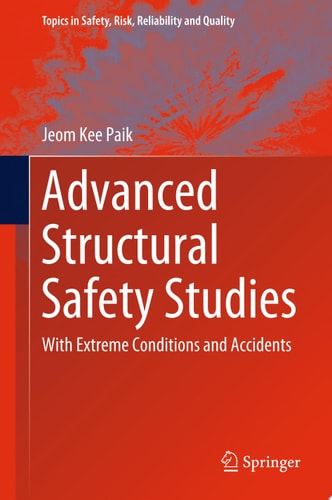
Advanced Structural Safety Studies
0
0
As an Amazon Associate and affiliate partner, Menrva Books earns from qualifying purchases. Learn more
Author Description
This book describes principles, industry practices and evolutionary methodologies for advanced safety studies, which are helpful in effectively managing volatile, uncertain, complex, and ambiguous (VUCA) environments within the framework of quantitative risk assessment and management and associated with the safety and resilience of structures and infrastructures with tolerance against various types of extreme conditions and accidents such as fires, explosions, collisions and grounding. It presents advanced computational models for characterizing structural actions and their effects in extreme and accidental conditions, which are highly nonlinear and non-Gaussian in association with multiple physical processes, multiple scales, and multiple criteria. Probabilistic scenario selection practices and applications are presented. Engineering practices for structural crashworthiness analysis in extreme conditions and accidents are described. Multidisciplinary approaches involving advanced computational models and large-scale physical model testing are emphasized. The book will be useful to students at a post-graduate level as well as researchers and practicing engineers.
Menrva's Summary
THE THESIS
This book investigates advanced methodologies for ensuring structural safety in volatile and complex environments. It details principles, industry practices, and evolutionary approaches for quantitative risk assessment and management, focusing on the resilience of structures and infrastructures against extreme conditions like fires, explosions, collisions, and grounding. The text presents advanced computational models for characterizing structural actions and their effects under highly nonlinear and non-Gaussian conditions, incorporating multiple physical processes, scales, and criteria. Probabilistic scenario selection and engineering practices for structural crashworthiness analysis are also covered, emphasizing multidisciplinary approaches that combine advanced modeling with large-scale physical testing.
THE SCOPE MAP
- Principles, industry practices, and evolutionary methodologies for advanced safety studies.
- Quantitative risk assessment and management frameworks for structural and infrastructure resilience.
- Advanced computational models for characterizing structural actions and effects in extreme and accidental conditions.
- Probabilistic scenario selection practices and applications.
- Engineering practices for structural crashworthiness analysis.
- Emphasis on multidisciplinary approaches involving computational models and physical testing.
THE AUTHORITY PERSPECTIVE
The book is positioned as a valuable resource for postgraduate students, researchers, and practicing engineers in the field of structural safety. Its comprehensive coverage of advanced computational models and multidisciplinary approaches suggests a text aimed at providing in-depth knowledge for tackling complex engineering challenges. The focus on quantitative risk assessment and resilience against extreme events indicates its relevance for professionals dealing with high-stakes structural integrity.
Page Count:
664
Publication Date:
2019-07-25
Publisher:
Springer Nature
ISBN-10:
981138245X
ISBN-13:
9789811382451
Non-Fiction
Science & Technology
Engineering
Structural Engineering
Community Tags
Similar Books