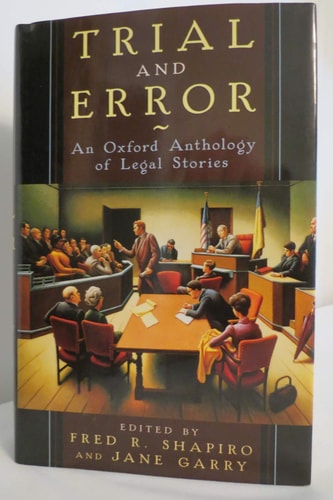
Trial and Error: An Oxford Anthology of Legal Stories
0
0
As an Amazon Associate and affiliate partner, Menrva Books earns from qualifying purchases. Learn more
Author Description
The courtroom has always contained many of the elements of great literature--conflict, suspense, high drama, and human tragedy. Indeed, the courtroom is a stage on which the noblest passions and basest instincts are played out before a jury who, much like the readers of a story or a novel, must interpret the evidence and formulate a judgment. It is not surprising, then, that law has attracted writers from Sophocles to Joyce Carol Oates, and that some of the most compelling moments in fiction arise from legal conflicts, for the law raises many of the most fundamental human issues: How can we know the truth? How do we decide between mercy and punishment? How can the impersonal machinery of the legal system protect the rights of the individual?In Trial and Error: An Oxford Book of Legal Stories, Fred R. Shapiro and Jane Garry bring together thirty-two riveting stories, excerpts from novels, and nonfiction essays about the human dimensions of the law. From Sir Walter Scott's "The Two Drovers" (1827), to Ernest J. Gaines's A Lesson Before Dying (1993), the selections gathered here vividly dramatize the legal process. We see the law as a vehicle of frustration and inertia in Dickens's Bleak House, as a baffling affront to common sense in Mark Twain's Roughing It, as a forum for humiliation and cruelty in Robert Louis Stevenson's Weir of Hermiston, as a cynical and racist form of expediency in James Alan McPherson's "An Act of Prostitution," and as a battleground for the possession of a child in Sue Miller's The Good Mother. Here we find lawyers, criminal defendants, litigants, clients, judges, police, jurors, and witnesses, all of them depicted with veracity and insight. Many of the writers in this anthology either practiced or studied law, or were themselves involved in litigation; those who weren't, apply powers of observation to a process that affects us all. Thus, from George Eliot, Herman Melville, Anthony Trollope, and Frank O'Connor to William Faulkner, George Orwell
Menrva's Summary
THE PULSE
This anthology examines the intersection of legal systems and human experience through a curated collection of narratives centered on courtroom drama and judicial conflict.
Editors Fred R. Shapiro and Jane Garry assemble thirty-two distinct pieces, ranging from classic literature to contemporary fiction and nonfiction essays. The collection explores the tension between the impersonal machinery of the law and the individual lives caught within its reach. By presenting a variety of perspectives—from defendants and jurors to lawyers and judges—the book highlights the moral complexities inherent in the pursuit of truth and justice. The narrative framework shifts between historical fiction, realist prose, and analytical essays, providing a multifaceted view of the legal process.
INSIDE THE PAGES
- Inclusion of classic literary excerpts from authors such as Charles Dickens and Sir Walter Scott.
- Exploration of the law as a source of both social order and individual frustration.
- Examination of the ethical dilemmas regarding mercy versus punishment.
- Depiction of diverse legal roles including litigants, police, and witnesses.
- Analysis of the law as a battleground for human rights and personal autonomy.
- Inclusion of nonfiction essays that provide context to the fictional legal scenarios.
- Focus on the human dimensions of litigation and the fallibility of the judicial system.
- Chronological breadth spanning from the 19th century to the late 20th century.
THE COLLECTIVE ECHO
Readers and critics frequently note the anthology's success in capturing the dramatic potential of the courtroom as a literary setting. Discussion often centers on the variety of authors included, which allows for a broad comparison of how different eras and cultures perceive legal authority. The pacing is varied due to the mix of short stories and novel excerpts, keeping the reader engaged with shifting tones and themes. Many highlight the effectiveness of the editors' selections in illustrating the law as a deeply human, often flawed, institution. The collection is widely regarded as a thoughtful examination of how legal conflicts mirror the fundamental struggles of the human condition.
Page Count:
496
Publication Date:
1998-02-19
Publisher:
Oxford University Press
ISBN-10:
0195095472
ISBN-13:
9780195095470
Fiction
Short Stories
Great Britain
Law
Essays
Anthology
Community Tags
Similar Books