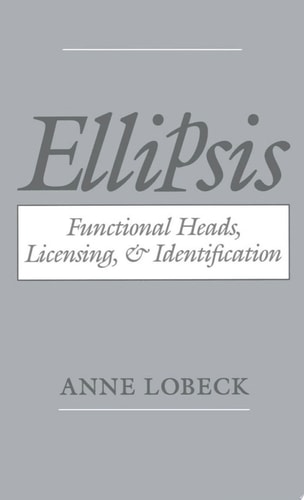
Ellipsis: Functional Heads, Licensing, and Identification
0
0
As an Amazon Associate and affiliate partner, Menrva Books earns from qualifying purchases. Learn more
Author Description
This book elaborates a theory of ellipsis that sheds new light on a well-known phenomenon, bringing it under the aegis of general and universal principles. Lobeck argues that ellipted categories in IP (VP Ellipsis), DP (N' Ellipsis), and CP (Sluicing) are empty, non-referential pronominals, subject to the same licensing and identification conditions as referential pro. She proposes that both types of empty pronominals must be licensed under head-government to satisfy the Empty Category Principle, and identified through strong agreement. In the case of ellipsis, agreement-type features make the empty category visible to interpretive processes of reconstruction. These licensing and identification conditions derive the result that ellipses are complements of functional categories DET, COMP, and INFL, but not of lexical categories. The analysis is supported by contrastive evidence from ellipsis in French and German, in which licensing and identification interact with Verb Raising, feature checking, and a parameter defining "strong" agreement.
Menrva's Summary
THE THESIS
This book investigates the theoretical mechanisms governing ellipsis by proposing that ellipted categories function as empty, non-referential pronominals subject to universal licensing and identification conditions. Anne C. Lobeck, a scholar in generative syntax, utilizes the framework of the Empty Category Principle to argue that ellipsis is not a disparate phenomenon but one governed by the same constraints as referential pro. By examining the relationship between functional categories and empty categories, the author provides a unified account of how agreement-type features facilitate the reconstruction of missing information in language.
THE SCOPE MAP
What You Will Find
- Analysis of VP Ellipsis, N' Ellipsis, and Sluicing within the IP, DP, and CP structures.
- Application of the Empty Category Principle and head-government licensing conditions.
- Comparative linguistic evidence drawn from French and German syntax.
- Examination of Verb Raising, feature checking, and the role of strong agreement in identifying empty categories.
THE AUTHORITY PERSPECTIVE
Linguists and syntax researchers frequently cite this work as a foundational text for understanding the formal constraints on ellipsis within generative grammar. The prose is highly technical and intended for an academic audience familiar with the principles of government and binding theory.
Page Count:
224
Publication Date:
1995-06-22
Publisher:
Oxford University Press
ISBN-10:
0195091817
ISBN-13:
9780195091816
Academic
Grammar
Study & Teaching
Linguistics
Syntax
Community Tags
Similar Books