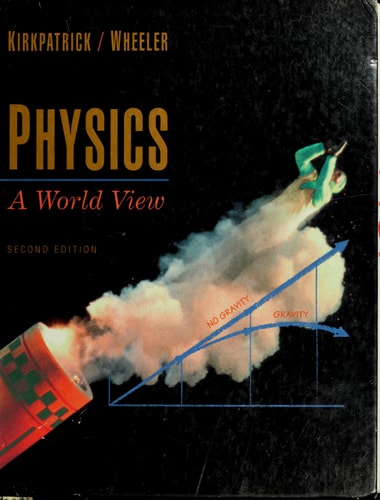
Physics: A world view (Saunders golden sunburst series)
0
0
As an Amazon Associate and affiliate partner, Menrva Books earns from qualifying purchases. Learn more
Author Description
This text offers a conceptual survey of physics in an easily understood presentation. * The flexible organisation allows professors to choose the order in which topics are taught. Seven possible thematic paths are detailed in the Instructor's Manual. * Chapter-opening questions immediately stimulate independent thinking about forthcoming chapter topics. * Excellent illustrations and photos complement text and maintain student interest throughout the course. * In-text questions with answers at the bottom of the page help students think critically about important chapter material. * Physics on Your Own boxes, requiring little or no equipment, illustrate the experimental aspects of physics and the application of physics to our everyday lives. * Special topic boxes expose students to various practical and interesting applications of physical principles. * Biographical sketches give students a valuable historical perspective of physics. * Specially placed "Interludes" prepare students for chapters that follow. New to this * "Computing Boxes" offer students optional opportunities to explore the mathematics often associated with the physics course. * Brilliant new photographs, including some in end-of-chapter pedagogy, complement chapter material and capture student interest. * Updated topics in pedagogical boxes (e.g. the 1996 Olympic Games) include the latest information about physics and illustrate the relevancy of physics in our daily lives. * Updated end-of-chapter questions challenge students to apply important concepts to contemporary situations. * Updated developing areas such as elementary particles and lasers, added new explanations on the global positioning system, reactions caused by collision, increased coverage of the physics of biology and medicine.
Menrva's Summary
THE THESIS
How can the fundamental principles of physics be communicated to students through a conceptual, rather than purely mathematical, framework? Larry D. Kirkpatrick, a seasoned educator, utilizes a conceptual survey approach to demystify physical laws for undergraduate students. By prioritizing qualitative understanding over complex algebraic derivation, the text provides a structured path for learners to grasp the mechanics of the universe through historical context, practical application, and experimental observation.
THE SCOPE MAP
What You Will Find
- Conceptual explanations of classical and modern physics topics including elementary particles and lasers.
- Pedagogical tools such as chapter-opening questions, in-text self-assessment queries, and biographical sketches.
- Practical application modules like 'Physics on Your Own' experiments and 'Computing Boxes' for optional mathematical exploration.
Scope Limits
- The text does not provide advanced, calculus-based derivations required for upper-level physics majors.
- It focuses primarily on survey-level breadth rather than deep theoretical specialization in any single sub-field.
THE AUTHORITY PERSPECTIVE
Educators frequently utilize this text as a foundational resource for non-major physics courses due to its accessible prose and modular organization. Experts highlight the balance between historical context and contemporary applications as a primary strength for maintaining student engagement in introductory settings.
Page Count:
672
Publication Date:
1995-01-01
Publisher:
Saunders College Pub
ISBN-10:
0030006023
ISBN-13:
9780030006029
Science
textbook
Physics
Academic
New Used & Rental Textbooks
Education
Community Tags
Similar Books