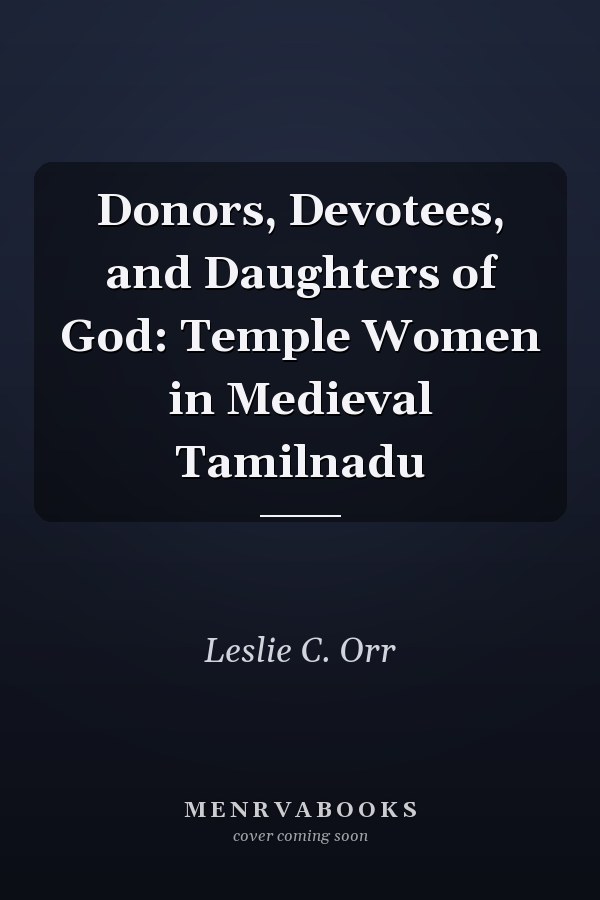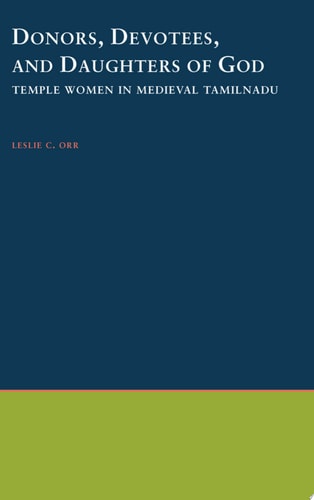
Donors, Devotees, and Daughters of God: Temple Women in Medieval Tamilnadu
0
0
As an Amazon Associate and affiliate partner, Menrva Books earns from qualifying purchases. Learn more
Author Description
Through the use of epigraphical evidence, Leslie C. Orr brings into focus the activities and identities of the temple women (devadasis) of medieval South India. This book shows how temple women's initiative and economic autonomy involved them in medieval temple politics and allowed them to establish themselves in roles with particular social and religious meanings. This study suggests new ways of understanding the character of the temple woman and, more generally, of the roles of women in Indian religion and society.
Menrva's Summary
THE THESIS
This book investigates the socio-economic and religious roles of temple women, known as devadasis, in medieval Tamilnadu to challenge traditional perceptions of their status. Leslie C. Orr, a scholar of South Asian religions, utilizes extensive epigraphical evidence—inscriptions found on temple walls—to reconstruct the lives of these women. By analyzing their financial transactions, land ownership, and participation in temple administration, the author argues that these women possessed significant economic autonomy and political influence. The work provides a nuanced framework for understanding how gender roles were negotiated within the complex religious landscape of medieval South India.
THE SCOPE MAP
What You Will Find
- Analysis of medieval Tamilnadu epigraphical records and temple inscriptions.
- Examination of the economic autonomy and land-holding practices of temple women.
- Investigation into the intersection of religious service and political influence in South Indian temples.
- A re-evaluation of the social identity and agency of the devadasis within the broader context of Indian history.
THE AUTHORITY PERSPECTIVE
Scholars in the field of South Asian history recognize this work as a foundational text for understanding the agency of women in pre-modern religious institutions. Readers frequently note the academic density of the prose, which relies heavily on the interpretation of primary source inscriptions to support its historical arguments.
Page Count:
318
Publication Date:
2000-03-09
Publisher:
Oxford University Press
ISBN-10:
0195099621
ISBN-13:
9780195099621
Religion
History
Women Studies
Religious Life