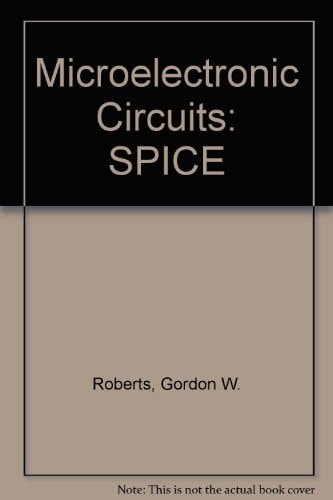
SPICE for Microelectronic Circuits
0
0
As an Amazon Associate and affiliate partner, Menrva Books earns from qualifying purchases. Learn more
Author Description
This book describes how Spice is used to analyze microelectronic circuits and more importantly, outline how Spice is used in the process of design itself. In many cases, most of the design effort is spent blindly searching for ways to improve the design itself using a brute-force hit-and-miss approach. The intention of this book is to avoid this pitfall and teach the reader what not to do with Spice. This is accomplisthed by keying each example of this text to those presented in Microelectronic Circuits, 3/E, where a complete hand analysis is provided. The beauty of this book is that it can also stand alone as a manual for compuer-aided circuit analysis for microelectronic circuits.
Menrva's Summary
THE THESIS
This text investigates the effective integration of SPICE simulation software into the microelectronic circuit design process to move beyond trial-and-error methodologies. Authors Adel S. Sedra and Gordon W. Roberts, both established figures in electrical engineering education, argue that simulation should serve as a diagnostic and refinement tool rather than a substitute for fundamental circuit analysis. By aligning simulation examples with established hand-analysis techniques, the authors provide a framework for systematic design optimization.
THE SCOPE MAP
What You Will Find
- Methodologies for transitioning from manual circuit analysis to computer-aided simulation
- Strategies for avoiding brute-force design iterations in SPICE
- Comparative analysis between hand-calculated results and simulation outputs
- Practical workflows for circuit verification and performance improvement
THE AUTHORITY PERSPECTIVE
Experts and educators frequently cite this work as a critical companion to foundational microelectronics curricula, noting its utility in bridging the gap between theoretical analysis and practical software application. Readers often highlight the clarity of the examples, which effectively demonstrate how to use simulation tools to validate design decisions rather than relying on blind experimentation.
Page Count:
648
Publication Date:
1995-06-08
Publisher:
Oxford University Press
ISBN-10:
0195105842
ISBN-13:
9780030526176
Technology
Integrated Circuits
Printed Circuits
Circuit Design
Computer Aided Design
Engineering
Electronics
Spice Computer Program
Community Tags
Similar Books