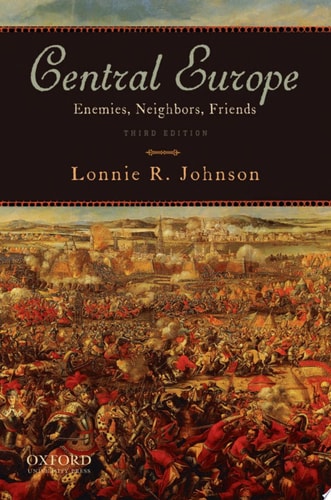
Central Europe: Enemies, Neighbors, Friends
0
0
As an Amazon Associate and affiliate partner, Menrva Books earns from qualifying purchases. Learn more
Author Description
Throughout the Cold War era, the Iron Curtain divided Central Europe into a Communist East and a democratic West, and we grew accustomed to looking at this part of the world in bipolar ideological terms. Yet many people living on both sides of the Iron Curtain considered themselves Central Europeans, and the idea of Central Europe was one of the driving forces behind the revolutionary year of 1989 as well as the deterioration of Yugoslavia and its ensuing wars.Central Europe provides a broad overview and comparative analysis of key events in a historical region that encompasses contemporary Germany, Poland, the Czech Republic, Slovakia, Austria, Hungary, Slovenia, and Croatia. Starting with the initial conversion of the "pagan" peoples of the region to Christianity around 1000 A.D. and concluding with the revolutions of 1989 and the problems of post-Communist states today, it illuminates the distinctive nature and peculiarities of the historical development of this region as a cohesive whole. Lonnie R. Johnson introduces readers to Central Europe's heritage of diversity, the interplay of its cultures, and the origins of its malicious ethnic and national conflicts. History in Central Europe, he shows, has been epic and tragic. Throughout the ages, small nations struggled valiantly against a series of imperial powers--Ottoman Turkey, Habsburg Austria, imperial Germany, czarist Russia, Nazi Germany, and the Soviet Union--and they lost regularly. Johnson's account is present-minded in the best sense: in describing actual historical events, he illustrates the ways they have been remembered, and how they contribute to the national assumptions that still drive European politics today. Indeed, the constant interplay of reality and myth--the processes of myth-making and remembrance--animates much of this history.Since the fall of the Iron Curtain in 1989, the unanticipated problems of transforming post-Communist states into democracies with market economies, the wars in the
Menrva's Summary
THE THESIS
This work investigates the historical, cultural, and political forces that have defined Central Europe as a distinct region despite centuries of imperial domination and ideological division. Lonnie R. Johnson, an expert in Central European studies, synthesizes a millennium of history to argue that the region's identity is shaped by a persistent tension between its diverse cultural heritage and the myth-making processes used by nationalistic movements. By examining the interplay between historical reality and collective memory, the author provides a framework for understanding the challenges faced by post-Communist states in their transition to democracy and market economies.
THE SCOPE MAP
What You Will Find
- A comprehensive historical survey spanning from the Christianization of the region around 1000 A.D. to the post-1989 political landscape.
- Comparative analysis of the national trajectories of Germany, Poland, the Czech Republic, Slovakia, Austria, Hungary, Slovenia, and Croatia.
- Examination of the impact of major imperial powers including the Ottoman, Habsburg, Nazi, and Soviet regimes on regional development.
- Analysis of the role of myth-making and historical remembrance in shaping contemporary European political assumptions.
THE AUTHORITY PERSPECTIVE
Experts and historians recognize this text as a valuable, broad-reaching synthesis that successfully navigates the complex, often tragic history of the region. Readers frequently note the accessibility of the prose, which manages to distill dense historical developments into a coherent narrative suitable for both students and general readers interested in European affairs.
Page Count:
339
Publication Date:
1996-10-31
Publisher:
Oxford University Press
ISBN-10:
0195100719
ISBN-13:
9780195100716
History
Europe central
Central Europe
European History
International relations
Community Tags
Similar Books