Chemical Bonding and Molecular Geometry: From Lewis to Electron Densities
0
0
As an Amazon Associate and affiliate partner, Menrva Books earns from qualifying purchases. Learn more
Author Description
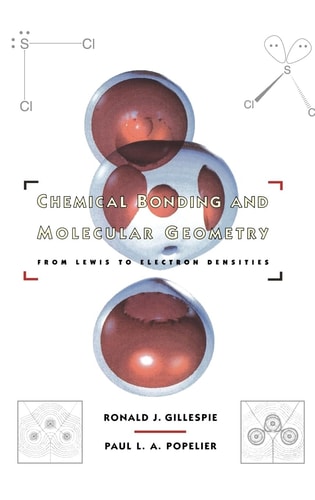
Ideal for undergraduate and first-year graduate courses in chemical bonding, Chemical Bonding and Molecular Geometry: From Lewis to Electron Densities can also be used in inorganic chemistry courses. Authored by Ronald Gillespie, a world-class chemist and expert on chemical bonding, and Paul Popelier of the University of Manchester Institute of Science and Technology, this text provides students with a comprehensive and detailed introduction to the principal models and theories of chemical bonding and geometry. It also serves as a useful resource and an up-to-date introduction to modern developments in the field for instructors teaching chemical bonding at any level.Features:* Shows students how the concept of the chemical bond has developed from its earliest days, through Lewis's brilliant concept of the electron pair bond and up to the present day* Presents a novel, non-traditional approach that emphasizes the importance of the Pauli principle as a basis for understanding bonding* Begins with the fundamental classical concepts and proceeds through orbital models to recent ideas based on the analysis of electron densities, which help to clarify and emphasize many of the limitations of earlier models* Provides a thorough and up-to-date treatment of the well-known valence-shell electron pair (VSEPR) model (which was first formulated and developed by author Ronald Gillespie) and the more recent ligand close-packing (LCP) model* Presents a unique pictorial and nonmathematical discussion of the analysis of electron density distributions using the atoms in molecules (AIM) theory* Emphasizes the relationships between these various models, giving examples of their uses, limitations, and comparative advantages and disadvantages
Menrva's Summary
THE THESIS
This text investigates the evolution and application of chemical bonding models, ranging from classical Lewis structures to contemporary electron density analysis. Authored by Ronald J. Gillespie, a pioneer of the VSEPR model, and Paul L. A. Popelier, the book provides a structured pedagogical framework for understanding molecular geometry. It synthesizes historical developments with modern theoretical advancements to offer a comprehensive overview of how bonding principles are applied in inorganic chemistry.
THE SCOPE MAP
What You Will Find
- Historical development of chemical bonding theories from Lewis structures to modern electron density models.
- Detailed treatment of the valence-shell electron pair (VSEPR) model and the ligand close-packing (LCP) model.
- Non-mathematical, pictorial analysis of the atoms in molecules (AIM) theory.
- Comparative analysis of the advantages, limitations, and interrelationships between various bonding models.
THE AUTHORITY PERSPECTIVE
Experts recognize this work as a significant resource for students and instructors due to its focus on the foundational principles of molecular geometry. Readers frequently note the clarity of the non-mathematical explanations, making it a valuable reference for those seeking to understand the transition from classical to modern bonding theories.
Page Count:
288
Publication Date:
2001-03-08
Publisher:
Oxford University Press
ISBN-10:
0195104951
ISBN-13:
9780195104950
Science
Inorganic Chemistry
Molecules
Academic
textbook
Chemical bonds
Chemistry
Community Tags
Similar Books