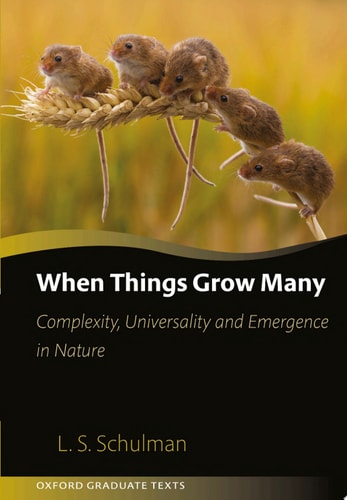
When Things Grow Many: Complexity, Universality and Emergence in Nature
0
0
As an Amazon Associate and affiliate partner, Menrva Books earns from qualifying purchases. Learn more
Author Description
Aimed at advanced undergraduates and graduate students, When Things Grow Many is an accessible and engaging textbook introducing the theory of statistical mechanics, as well as its fascinating real-world applications. The book's original approach, which covers interdisciplinary applications of statistical mechanics to a wide range of subjects, including chemistry, biology, linguistics, economics, sociology and more, is bound to appeal to a wide audience. While the first part of the book introduces the various methods of statistical physics, including complexity, emergence, universality, self-organized criticality, power laws and other timely topics, the final sections focus on specific relevance of these methods to the social, biological and physical sciences. The mathematical content is woven throughout the book in the form of equations, as well as further background and explanations being provided in footnotes and appendices.
Menrva's Summary
THE THESIS
This text investigates how statistical mechanics provides a unified framework for understanding complex systems and emergent phenomena across diverse scientific disciplines. Lawrence Schulman, a physicist with extensive academic experience, utilizes a pedagogical approach that bridges foundational physics with interdisciplinary applications. The book argues that the principles of universality and self-organized criticality are not limited to physical systems but are essential for analyzing patterns in biology, linguistics, and the social sciences.
THE SCOPE MAP
What You Will Find
- Theoretical foundations of statistical physics including complexity, emergence, and universality.
- Analysis of power laws and self-organized criticality.
- Interdisciplinary case studies spanning chemistry, biology, linguistics, economics, and sociology.
- Mathematical derivations supported by footnotes and appendices.
Scope Limits
- The text assumes a baseline knowledge of physics and mathematics suitable for advanced undergraduates.
- It does not provide an exhaustive historical account of the field, focusing instead on contemporary applications and methodology.
THE AUTHORITY PERSPECTIVE
Academic reviewers and instructors frequently note the text's success in making abstract statistical concepts accessible through its broad range of real-world examples. Experts highlight this as a valuable resource for students seeking to apply physical modeling techniques to complex systems outside of traditional physics curricula.
Page Count:
426
Publication Date:
2021-01-01
Publisher:
OUP Oxford
ISBN-10:
019260645X
ISBN-13:
9780192606457
Science
Mathematical Physics
Dynamics
Statistical mechanics
Academic
Earth Sciences
Physics
Complexity Theory
textbook
Community Tags
Similar Books