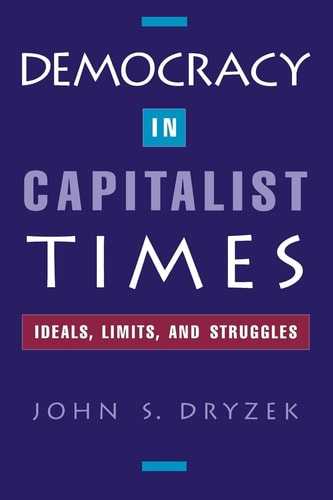
Democracy in Capitalist Times: Ideals, Limits, and Struggles
0
0
As an Amazon Associate and affiliate partner, Menrva Books earns from qualifying purchases. Learn more
Author Description
Democracy is under threat from a variety of forces originating in the transnational capitalist economy. Structural economic pressures force states to act in certain ways, regardless of what their populations want or think. In Democracy in Capitalist Times, John S. Dryzek discusses the challenges transnational capitalism presents for democracy and the most promising places where democracy can find new and growing support. Dryzek links contemporary political theory and comparative politics to explore the contradictions between capitalism and democracy. While ideological forces limit the range of political debate, government and market together promote aggressive individualism, under which people compete as consumers and profit maximizers rather than associate as citizens. Dryzek outlines these forces, considers how democracy might be defended against them, and explores the prospects for deepening democracy in the face of these threats. He argues that while state democracy has significantly diminished, democracy in different places, notably civil society, social movements, workplaces, and transnational politics, is on the rise, and it is in these places that democrats should concentrate their efforts. Dryzek further explains that the health of democratic politics in these alternative locations crucially depends on how states organize patterns of interest representation, among which social democratic corporatism proves to be most conducive to democracy.
Menrva's Summary
THE THESIS
This book investigates the inherent contradictions between transnational capitalism and democratic governance, questioning how democratic ideals can survive and expand under current economic pressures. John S. Dryzek, a prominent political theorist, utilizes a framework that bridges contemporary political theory and comparative politics to analyze how market forces and structural economic pressures constrain state-level democracy. He argues that while traditional state-based democratic institutions are in decline, alternative sites of democratic engagement offer potential for renewal. The work provides a systematic assessment of how social movements, civil society, and specific state organizational patterns can resist the atomizing effects of aggressive individualism.
THE SCOPE MAP
What You Will Find
- Analysis of the structural constraints imposed by transnational capitalism on national policy-making.
- Evaluation of social democratic corporatism as a mechanism for interest representation.
- Examination of democratic potential within civil society, workplaces, and transnational political arenas.
- Theoretical exploration of the tension between consumer-driven individualism and citizen-based association.
THE AUTHORITY PERSPECTIVE
Scholars in political science frequently cite this work for its clear articulation of the systemic challenges facing modern democratic states. Experts note that the text serves as a foundational resource for understanding the intersection of political theory and global economic structures.
Page Count:
192
Publication Date:
1996-08-15
Publisher:
Oxford University Press
ISBN-10:
0195106008
ISBN-13:
9780195106008
Democracy
Capitalism
Comparative Politics
Sociology
Political Theory
Community Tags
Similar Books