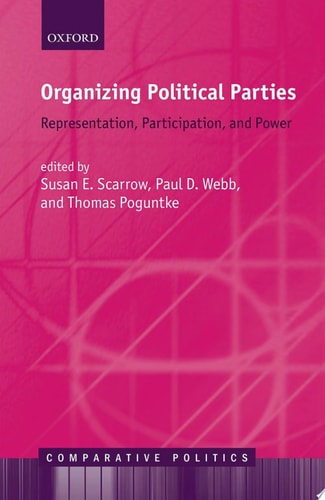
Organizing Political Parties
0
0
As an Amazon Associate and affiliate partner, Menrva Books earns from qualifying purchases. Learn more
Author Description
Political Party Organizations Play Large Roles In Democracies, Yet Their Organizations Differ Widely, And Their Statutes Change Much More Frequently Than Constitutions Or Electoral Laws. How Do These Differences, And These Frequent Changes, Affect The Operation Of Democracy? This Book Seeks To Answer These Questions By Presenting A Comprehensive Overview Of The State Of Party Organization In Nineteen Contemporary Democracies. Using A Unique New Data Collection, The Book's Chapters Test Propositions About The Reasons For Variation And Similarities Across Party Organizations. They Find More Evidence Of Within-country Similarity Than Of Cross-national Patterns Based On Party Ideology. After Exploring Parties' Organizational Differences, The Remaining Chapters Investigate The Impact Of These Differences. The Volume Considers A Wide Range Of Theories About How Party Organization May Affect Political Life, Including The Impact Of Party Rules On The Selection Of Female Candidates, The Links Between Party Decision Processes And The Stability Of Party Programmes, The Connection Between Party Finance Sources And Public Trust In Political Parties, And Whether The Strength Of Parties' Extra-parliamentary Organization Affects The Behaviour Of Their Elected Legislators. Collectively These Chapters Help To Advance Comparative Studies Of Elections And Representation By Inserting Party Institutions And Party Agency More Firmly Into The Centre Of Such Studies. Comparative Politics Is A Series For Researchers, Teachers, And Students Of Political Science That Deals With Contemporary Government And Politics. Global In Scope, Books In The Series Are Characterised By A Stress On Comparative Analysis And Strong Methodological Rigour. The Series Is Published In Association With The European Consortium For Political Research. For More Information Visit: Www.ecprnet.eu. The Series Is Edited By Emilie Van Haute, Professor Of Political Science, Université Libre De Bruxelles; Ferdinand Müller-ro
Menrva's Summary
THE THESIS
This book investigates how the organizational structures of political parties and their frequent internal rule changes influence the broader functioning of contemporary democracies. The authors, a team of distinguished political scientists, utilize a comprehensive, original dataset covering nineteen democracies to test hypotheses regarding why party organizations vary and how these differences impact political outcomes. By shifting the focus toward party institutions and agency, the text provides a framework for understanding the internal mechanics that shape political representation and legislative behavior.
THE SCOPE MAP
What You Will Find
- A comparative analysis of party organization across nineteen contemporary democracies.
- Empirical testing of propositions regarding organizational variation and similarity.
- Investigations into the impact of party rules on candidate selection, program stability, finance, and legislative behavior.
Scope Limits
- The study focuses primarily on institutional and organizational dynamics rather than individual voter psychology or electoral behavior.
- The analysis is restricted to the nineteen democracies included in the specific dataset rather than a global survey of all political systems.
THE AUTHORITY PERSPECTIVE
Experts recognize this volume as a rigorous contribution to the field of comparative politics, particularly for its methodological focus on party institutions. Scholars and students frequently cite the work for its systematic approach to linking internal party rules with broader democratic outcomes.
Page Count:
384
Publication Date:
2017-01-01
Publisher:
Oxford University Press
ISBN-10:
0191076333
ISBN-13:
9780191076336
Comparative Politics
Public Policy
Democracy
Government
Community Tags
Similar Books



Reader Comments
Share Your Thoughts
No comments yet. Be the first to share your thoughts!