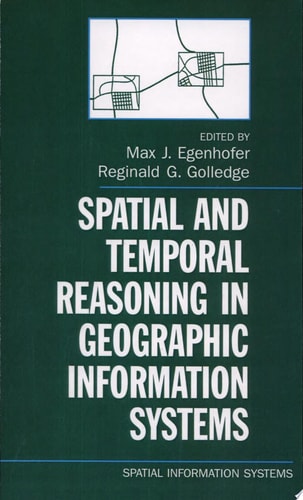
Spatial and Temporal Reasoning in Geographic Information Systems
0
0
As an Amazon Associate and affiliate partner, Menrva Books earns from qualifying purchases. Learn more
Author Description
In an effort to further investigation into critical development facets of geographic information systems (GIS), this book explores the reasoning processes that apply to geographic space and time. As a result of an iniative sponsored by the National Center for Geographic Information and Analysis (NCGIA), it treats the computational, cognitive and social science applications aspects of spatial and temporal reasoning in GIS. Essays were contributed by scholars from a broad spectrum of disciplines including: geography, cartography, surveying and engineering, computer science, mathematics and environmental and cognitive psychology.
Menrva's Summary
THE THESIS
This volume investigates the computational, cognitive, and social science frameworks required to model spatial and temporal reasoning within geographic information systems. The authors, Max J. Egenhofer and Reginald G. Golledge, compile research initiated by the National Center for Geographic Information and Analysis (NCGIA) to bridge the gap between theoretical spatial cognition and practical GIS implementation. By synthesizing contributions from diverse fields such as mathematics, engineering, and psychology, the text establishes a multidisciplinary foundation for understanding how humans and machines process geographic space and time.
THE SCOPE MAP
What You Will Find
- Computational models for representing spatial and temporal relationships in digital environments.
- Cognitive science perspectives on how human spatial reasoning informs system design.
- Interdisciplinary essays from experts in cartography, surveying, and environmental psychology.
- Methodologies for integrating social science applications into geographic information systems.
THE AUTHORITY PERSPECTIVE
Experts recognize this work as a foundational text for researchers and developers working at the intersection of GIS and cognitive science. Readers frequently note the academic density of the prose, which serves as a primary resource for understanding the theoretical underpinnings of spatial reasoning in modern information systems.
Page Count:
304
Publication Date:
1998-03-05
Publisher:
Oxford University Press
ISBN-10:
0195103424
ISBN-13:
9780195103427
Computer Science
Geography
Cartography
Information Systems
Community Tags
Similar Books