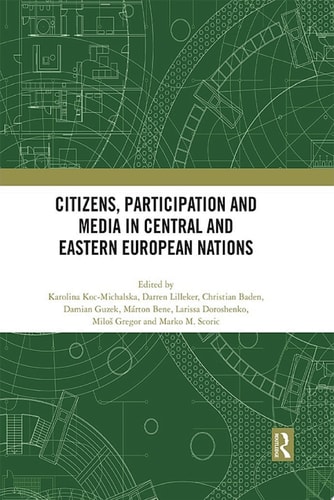
Citizens, Participation and Media in Central and Eastern European Nations
Karolina Koc-Michalska, Darren Lilleker, Christian Baden, Damian Guzek, Márton Bene, Larissa Doroshe
0
0
As an Amazon Associate and affiliate partner, Menrva Books earns from qualifying purchases. Learn more
Author Description
Central and Eastern European (CEE) countries have faced significant political, economic, social, and technological transformations over the last four decades. Democratic processes, after relative stabilisation, have begun to tremble again around polarizing values, populist leaders, or nationalistic ideologies. Online communication, especially social media platforms, play a vital role in shaping how citizens interact with the state, political actors, media, and other citizens. This book focuses on some of the challenges democratic institutions in Central and Eastern European (CEE) countries face in transforming and sustaining civil society and captures how the digital media environments mitigate or exacerbate those challenges. The chapters in this book focus on the role that online platforms play in shaping satisfaction with democracy in the CEE region, the interactions between journalists and political actors, the strategic media coverage of elections, affective polarisation and political antagonism, and discursive attempts to discourage young people from civic engagement. The first section of the book looks at CEE countries from a comparative perspective, and the second section examines specific case studies within different CEE countries such as Albania and Kosovo, Czechia and Hungary, Poland and Ukraine. This volume will be a key resource for scholars and researchers of Communication Studies, Politics, Media Studies, Sociology and Central and Eastern European studies. The chapters in this book were originally published in the Journal of Information, Technology & Politics.
Menrva's Summary
THE THESIS
This book investigates the complex interplay between digital media and democratic institutions in Central and Eastern European nations amidst resurgent political instability. It examines how online platforms, particularly social media, influence citizen interaction with the state, political actors, and each other, and whether these digital environments mitigate or exacerbate the challenges faced by transforming civil societies. The authors explore the role of online platforms in shaping satisfaction with democracy, the dynamics between journalists and politicians, strategic election coverage, affective polarization, and efforts to discourage youth civic engagement. The volume is structured into comparative analyses and specific case studies, offering a comprehensive look at the region's evolving political and media landscapes.
THE SCOPE MAP
- Comparative analysis of democratic institutions across Central and Eastern European countries.
- Case studies examining specific nations such as Albania, Kosovo, Czechia, Hungary, Poland, and Ukraine.
- The role of online platforms in shaping satisfaction with democracy.
- Interactions between journalists and political actors in the digital sphere.
- Strategic media coverage of elections in the region.
- Analysis of affective polarization and political antagonism.
- Discursive strategies aimed at discouraging young people from civic engagement.
- The impact of digital media environments on civil society transformation.
THE AUTHORITY PERSPECTIVE
This volume is positioned as a key resource for scholars and researchers in Communication Studies, Politics, Media Studies, Sociology, and Central and Eastern European studies. The chapters were originally published in the Journal of Information, Technology & Politics, suggesting a foundation in academic discourse and peer review. The focus on contemporary challenges to democracy and the role of digital media indicates a relevant and timely contribution to ongoing scholarly debates in the field. The comparative and case-study approach promises a nuanced understanding of the region's specific contexts.
Page Count:
168
Publication Date:
2024-12-02
Publisher:
Taylor & Francis
ISBN-10:
1040226396
ISBN-13:
9781040226391
Politics
Science & Technology
Non-Fiction
Sociology
Democracy
Media Studies
Digital Media
Community Tags
Similar Books