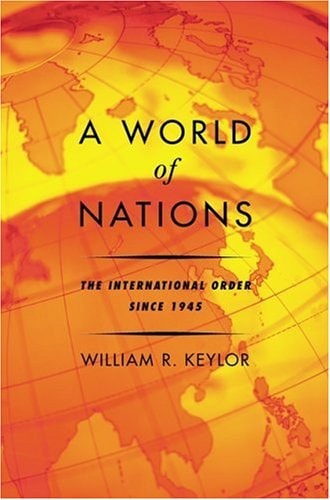
A World of Nations: The International Order Since 1945
0
0
As an Amazon Associate and affiliate partner, Menrva Books earns from qualifying purchases. Learn more
Author Description
A World of Nations: The International Order Since 1945 provides an analytical narrative of the origins, evolution, and end of the Cold War. But the book is more than an account of the long struggle between the two superpowers. It traces the development of regional conflicts--ethnic, religious, cultural, economic, and military--throughout the world and examines the salience of interstate conflicts in the era of globalization. Based on newly accessible historical records, including previously unavailable sources from the former Communist states, the book offers a genuinely international history of this turbulent period for the first time.When the Cold War came to an abrupt end in 1989-90, some observers prematurely predicted the "end of history" and the emergence of a new world order of peace and stability. Instead, the last decade of the twentieth century and the early years of the twenty-first have been marked by an explosion of regional conflicts that have little to do with the legacy of the Cold War. A World of Nations follows the roots of these regional conflicts to the early period after WWII, when the attention of the world--and of most historians--was riveted on policymaking in Washington and Moscow, not on smaller nations. While taking account of the phenomenon of globalization and its transnational forces in recent years, this book emphasizes the persistence of the nation-state as the dominant actor on the world stage. A World of Nations is ideal for undergraduate political science courses in international relations, as well as courses on the history of America, foreign policy, European diplomatic history, history of international relations, and world history.
Menrva's Summary
THE THESIS
This book investigates the evolution of the international order since 1945, questioning how the global landscape shifted from a bipolar Cold War struggle to the complex, fragmented geopolitical environment of the twenty-first century. William R. Keylor, a professor of history and international relations, utilizes newly accessible historical records from both Western and former Communist archives to construct his analysis. He argues that while globalization has introduced new transnational forces, the nation-state remains the primary actor in global affairs. The text provides a comprehensive framework for understanding how regional conflicts, often overlooked during the superpower rivalry, have shaped the modern world.
THE SCOPE MAP
What You Will Find
- A detailed historical analysis of international relations from the end of World War II through the early twenty-first century.
- Examination of the transition from Cold War bipolarity to the post-1989 era of regional instability.
- Integration of primary source documentation from previously classified archives in former Communist states.
- Analysis of the persistent role of the nation-state amidst the pressures of globalization and transnational economic forces.
THE AUTHORITY PERSPECTIVE
Experts and educators frequently identify this work as a foundational text for undergraduate courses in diplomatic history and international relations. Readers often note the academic density of the prose, which provides a rigorous, data-driven account of global political developments.
Page Count:
464
Publication Date:
2002-12-19
Publisher:
Oxford University Press
ISBN-10:
0195106024
ISBN-13:
9780195106022
History
Cold War
War
Diplomatic History
International relations
Community Tags
Similar Books