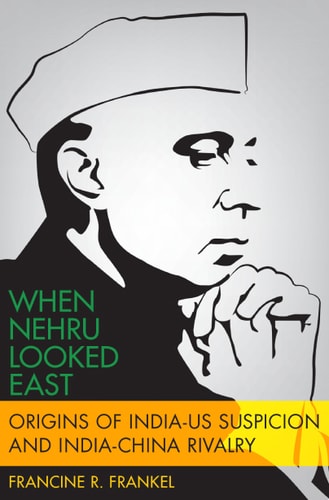
When Nehru Looked East: Origins of India-US Suspicion and India-China Rivalry
0
0
As an Amazon Associate and affiliate partner, Menrva Books earns from qualifying purchases. Learn more
Author Description
Jawaharlal Nehru, India's first Prime Minister and Minister of External Affairs from 1947 to 1964, set the framework of foreign policy which has remained India's reference point until the present. One of the most significant leaders of the twentieth century, Nehru came to power in the early years of the Cold War, determined to assert independent India's influence and interests in Asia and beyond. Drawing on the Nehru Papers, Francine Frankel's When Nehru Looked East reinterprets the doctrine of non-alignment with which Nehru is most closely identified to reveal its strategic purpose.Analyzing India-US and India-China relations during this period, Frankel explains how these parties came to distrust each other. From the outset, Nehru's vision of India's destiny as a great power collided with that of the US as leader and protector of the free world. He considered the US a rival in South and Southeast Asia and the Middle East and carried out an active diplomacy to dissuade newly independent nations from joining US-led anti-communist mutual security alliances and instead follow India's example of non-alignment. He did not see a threat from the Soviet Union and believed, despite the dispute with China over the northern border, that India's approach would bring India and China together as advocates of Asianism to counter American penetration in the region. This historic miscalculation, manifested in the 1962 China-India War, overthrew the pillars of Nehru's foreign policy.Frankel provides the most authoritative account yet of the origins of India-US suspicions and India-China rivalries. Outlasting the Cold War, Nehru's worldview lived on in the mindset of successor generations, making it difficult for the US and India to form a strategic partnership and establish a natural balance in Asia.
Menrva's Summary
THE THESIS
This book investigates the origins of the enduring strategic suspicion between India and the United States and the roots of the India-China rivalry during the tenure of Jawaharlal Nehru. Francine R. Frankel, a scholar of South Asian politics, utilizes the Nehru Papers to re-examine the doctrine of non-alignment. She argues that Nehru’s foreign policy was not merely a neutral stance but a calculated effort to assert Indian influence as a great power, which ultimately led to a historic miscalculation regarding China and a persistent friction with American interests in Asia.
THE SCOPE MAP
What You Will Find
- Analysis of Indian foreign policy from 1947 to 1964.
- Examination of the ideological collision between Nehru’s vision and US Cold War strategy.
- Investigation into the diplomatic failures leading to the 1962 China-India War.
- Assessment of how Nehru’s worldview influenced subsequent generations of Indian leadership.
Scope Limits
- The text focuses primarily on the Nehru era and does not provide an exhaustive history of post-1964 Indo-US relations.
- It does not cover domestic Indian policy except where it directly informs external diplomatic strategy.
THE AUTHORITY PERSPECTIVE
Experts recognize this work as a rigorous, primary-source-driven analysis of the foundational period of Indian diplomacy. Readers frequently note the academic density of the prose, which provides a detailed look at the strategic motivations behind Cold War-era geopolitical tensions.
Page Count:
364
Publication Date:
2020-01-06
Publisher:
Oxford University Press
ISBN-10:
019006434X
ISBN-13:
9780190064341
Politics
History
Politics & Government
Middle East
Social Science
China
Social History
Systems Theory
Asian Studies
Pakistan
Law
India
World politics
General
Diplomatic History
Sociology
Race Relations
International relations
New Used & Rental Textbooks
Asia
Cold War
Geopolitics
Community Tags
Other Editions(2)
Similar Books



Reader Comments
Share Your Thoughts
No comments yet. Be the first to share your thoughts!