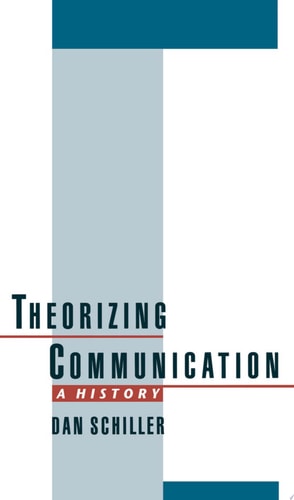
Theorizing Communication: A History
0
0
As an Amazon Associate and affiliate partner, Menrva Books earns from qualifying purchases. Learn more
Author Description
This book offers the first detailed intellectual history of communication study, from its beginnings in late nineteenth-century critiques of corporate capitalism and the burgeoning American wireline communications industry, to contemporary information theory and poststructuralist accounts of communicative activity. Schiller identifies a problematic split between manual and intellectual labor that outlasts each of the field's major conceptual departures, and from this vital perspective builds a rigorous critical survey of work aiming to understand the nexus of media, ideology, and information in a society. Looking closely at the thought of John Dewey, C. Wright Mills, Raymond Williams, Stuart Hall, Daniel Bell, and others, Schiller carefully maps the transformation of ideas about communication and culture as issues of corporate power, mass persuasion, cultural imperialism, and information expansion succeed one another in prominence. Bringing his analysis of communication theory into the present, Schiller concludes by limning a unitary model of society's cultural/informational production, one that broadens the concept of "labor" to include all forms of human self-activity. Powerful, challenging, and original, Theorizing Communication: A History offers a brilliantly constructed overview of the history of communication study, and will interest scholars working in the field as well as those working in critical theory, cultural studies, and twentieth-century intellectual history.
Menrva's Summary
THE THESIS
This book investigates the intellectual history of communication study by tracing its evolution from late nineteenth-century critiques of corporate capitalism to contemporary information theory. Dan Schiller, a scholar in the field, utilizes a critical framework to examine how the division between manual and intellectual labor has consistently shaped the discipline. By analyzing the works of influential thinkers such as John Dewey, C. Wright Mills, and Stuart Hall, the author argues that communication theory is inextricably linked to the shifting dynamics of corporate power, ideology, and information expansion. The text culminates in a proposed unitary model of cultural and informational production that redefines labor as a form of human self-activity.
THE SCOPE MAP
What You Will Find
- A historical survey of communication theory from the late nineteenth century to the present.
- Critical analysis of the relationship between media, ideology, and corporate capitalism.
- Examination of key intellectual figures including John Dewey, C. Wright Mills, Raymond Williams, Stuart Hall, and Daniel Bell.
- A theoretical framework proposing a unified model of society's cultural and informational production.
THE AUTHORITY PERSPECTIVE
Experts recognize this work as a significant contribution to the historiography of communication studies, noting its rigorous approach to linking media theory with broader socioeconomic shifts. Readers frequently highlight the academic density of the prose, which serves as a foundational text for those engaged in critical theory and cultural studies.
Page Count:
296
Publication Date:
1996-10-24
Publisher:
Oxford University Press
ISBN-10:
0195101995
ISBN-13:
9780195101997
Media Studies
Sociology
Intellectual History
Critical Theory
Communication
Communication Studies
Community Tags
Similar Books