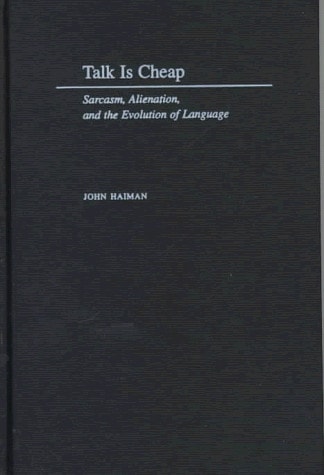
Talk Is Cheap: Sarcasm, Alienation, and the Evolution of Language
0
0
As an Amazon Associate and affiliate partner, Menrva Books earns from qualifying purchases. Learn more
Author Description
Putting aside questions of truth and falsehood, the old "talk is cheap" maxim carries as much weight as ever. Indeed, perhaps more. For one need not be an expert in irony or sarcasm to realize that people don't necessarily mean what they say. Phrases such as "Yeah, right" and "I couldn't care less" are so much a part of the way we speak--and the way we live--that we are more likely to notice when they are absent (for example, Forrest Gump). From our everyday dialogues and conversations ("Thanks a lot!") to the screenplays of our popular films (Pulp Fiction and Fargo), what is said is frequently very different from what is meant.Talk is Cheap begins with this telling observation and proceeds to argue that such "unplain speaking" is fundamentally embedded in the way we now talk. Author John Haiman traces this sea-change in our use of language to the emergence of a postmodern "divided self" who is hyper-conscious that what he or she is saying has been said before; "cheap talk" thus allows us to distance ourselves from a social role with which we are uncomfortable. Haiman goes on to examine the full range of these pervasive distancing mechanisms, from clichés and quotation marks to camp and parody. Also, and importantly, this text highlights several new ways in which the English language is evolving (and has evolved) in response to our postmodern world view. In other words, this study shows us how what we are saying is gradually separating itself from how we say it.As provocative as it is timely, the book will be fascinating reading for students of linguistics, literature, communication, anthropology, philosophy, and popular culture.
Menrva's Summary
THE THESIS
Does the prevalence of sarcasm and irony in modern discourse signal a fundamental shift in how human beings construct identity through language? John Haiman, a linguist, investigates the phenomenon of "cheap talk"—the disconnect between literal meaning and intended message—to argue that postmodern social alienation drives speakers to use irony, clichés, and parody as distancing mechanisms. By analyzing linguistic patterns alongside cultural artifacts, Haiman posits that modern speakers utilize these tools to navigate discomfort in their social roles and to manage the awareness that their expressions are often derivative.
THE SCOPE MAP
What You Will Find
- Analysis of linguistic distancing mechanisms including sarcasm, irony, clichés, and quotation marks.
- Examination of the "divided self" as a byproduct of postmodern social conditions.
- Case studies drawn from everyday conversation, popular film scripts, and literary examples.
- Theoretical exploration of how language evolution reflects changing societal worldviews.
THE AUTHORITY PERSPECTIVE
Experts in linguistics and communication recognize this work as a significant exploration of the intersection between sociolinguistics and postmodern cultural theory. Readers frequently note the accessible yet rigorous nature of the prose, which bridges the gap between academic inquiry and popular cultural analysis.
Page Count:
232
Publication Date:
1998-03-26
Publisher:
Oxford University Press
ISBN-10:
0195115244
ISBN-13:
9780195115246
Philosophy
Anthropology
Linguistics
Communication
Sociology
Community Tags
Other Editions(2)
Similar Books