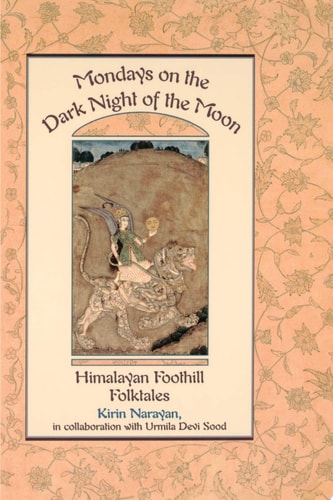
Mondays on the Dark Night of the Moon: Himalayan Foothill Folktales (Exeter Studies in History)
0
0
As an Amazon Associate and affiliate partner, Menrva Books earns from qualifying purchases. Learn more
Author Description
Oral tales establish relationships between storytellers and their listeners. Yet most printed collections of folktales contain only stories, stripped of the human contexts in which they are told. If storytellers are mentioned at all, they are rarely consulted about what meanings they see in their tales. In this innovative book, Indian-American anthropologist Kirin Narayan reproduces twenty-one folktales narrated in a mountain dialect by a middle-aged Indian village woman, Urmila Devi Sood, or "Urmilaji." The tales are set within the larger story of Kirin Narayan's research in the Himalayan foothill region of Kangra, and of her growing friendship with Urmilaji Sood. In turn, Urmilaji Sood supplements her tales with interpretations of the wisdom that she discerns in their plots. At a moment when the mass-media is flooding through rural India, Urmilaji Sood asserts the value of her tales which have been told and retold across generations. As she says, "Television can't teach you these things."These tales serve as both moral instruction and as beguiling entertainment. The first set of tales, focussing on women's domestic rituals, lays out guidelines for female devotion and virtue. Here are tales of a pious washerwoman who brings the dead to life, a female weevil observing fasts for a better rebirth, a barren woman who adopts a frog and lights ritual oil lamps, and a queen who remains with her husband through twelve arduous years of affliction. The women performing these rituals and listening to the accompanying stories are thought to bring good fortune to their marriages, and long life to their relatives. The second set of tales, associated with passing the time around the fire through long winter nights, are magical adventure tales. Urmilaji Sood tells of a matchmaker who marries a princess off to a lion, God splitting a boy claimed by two families into two selves, a prince's journey to the land of the demons, and a girl transformed into a bird by her stepmother.
Menrva's Summary
THE THESIS
This work investigates the vital role of oral storytelling in preserving cultural wisdom and social identity within the Himalayan foothills of India. Anthropologist Kirin Narayan challenges the traditional academic practice of stripping folktales of their human context by documenting the specific relationship between the storyteller, Urmila Devi Sood, and the researcher. Through this ethnographic framework, the book argues that these narratives function as essential moral and social instruction that remains relevant despite the encroachment of modern mass media.
THE SCOPE MAP
What You Will Find
- A collection of twenty-one distinct folktales transcribed from mountain dialect.
- An ethnographic analysis of the storyteller-listener relationship and its impact on narrative meaning.
- Primary source interpretations provided directly by the storyteller, Urmilaji Sood.
- A thematic exploration of domestic rituals, female virtue, and magical adventure tales.
THE AUTHORITY PERSPECTIVE
Scholars and anthropologists frequently cite this work as a model for reflexive ethnography that centers the voice of the informant. Readers often note the accessibility of the prose, which balances academic rigor with the warmth of the personal relationship between the author and her subject.
Page Count:
288
Publication Date:
1997-06-19
Publisher:
Oxford University Press
ISBN-10:
0195103491
ISBN-13:
9780195103496
History
Folklore
Anthropology
India religion
Asia
Sociology
Folklore_india
India
Community Tags
Similar Books