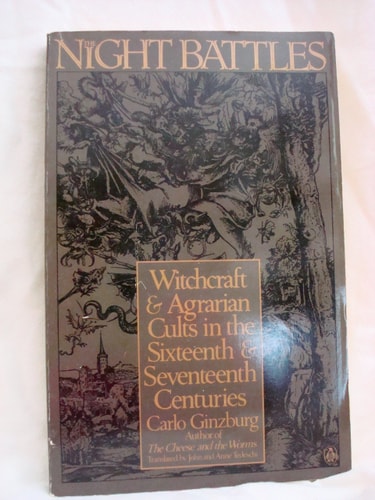
The Night Battles: Witchcraft and Agrarian Cults in the Sixteenth and Seventeenth Centuries
0
0
As an Amazon Associate and affiliate partner, Menrva Books earns from qualifying purchases. Learn more
Author Description
Based on research in the Inquisitorial archives, the book recounts the story of a peasant fertility cult centred on the benandanti. These men and women regarded themselves as professional anti-witches, who (in dream-like states) apparently fought ritual battles against witches and wizards, to protect their villages and harvests. If they won, the harvest would be good, if they lost, there would be famine. The inquisitors tried to fit them into their pre-existing images of the witches' sabbat. The result of this cultural clash which lasted over a century, was the slow metamorphosis of the benandanti into their enemies – the witches. Carlo Ginzburg shows clearly how this transformation of the popular notion of witchcraft was manipulated by the Inquisitors, and disseminated all over Europe and even to the New World. The peasants' fragmented and confused testimony reaches us with great immediacy, enabling us to identify a level of popular belief which constitutes a valuable witness for the reconstruction of the peasant way of thinking of this age.
Menrva's Summary
THE THESIS
This work investigates the historical origins and subsequent transformation of the benandanti, a peasant fertility cult in sixteenth and seventeenth-century Italy, as they were assimilated into the Inquisitorial framework of witchcraft. Carlo Ginzburg, a prominent historian of microhistory, utilizes extensive primary source material from Inquisitorial archives to reconstruct the belief systems of rural peasants. He argues that the Inquisitors systematically manipulated the testimony of these individuals to align with established theological constructs of the witches' sabbat, ultimately altering the cultural identity of the practitioners themselves.
THE SCOPE MAP
What You Will Find
- Analysis of Inquisitorial trial records from the Friuli region of Italy.
- Examination of the transition from agrarian fertility rites to the demonological classification of witchcraft.
- Documentation of the cultural collision between peasant belief systems and institutional ecclesiastical authority.
Scope Limits
- The study is geographically focused on the Friuli region and does not provide a comprehensive survey of all European witchcraft trials.
- The analysis does not attempt to validate the supernatural claims of the benandanti but focuses on the sociological and historical implications of their testimony.
THE AUTHORITY PERSPECTIVE
Historians frequently cite this work as a foundational text in the field of microhistory for its innovative use of archival records to uncover subaltern perspectives. Scholars often note the precision of Ginzburg's methodology in demonstrating how institutional power structures can reshape popular culture over time.
Page Count:
209
Publication Date:
1985-03-05
Publisher:
Penguin Books
ISBN-10:
0140076883
ISBN-13:
9780140076882
History
Folklore
Cultural History
Anthropology
European History
Microhistory
Witchcraft