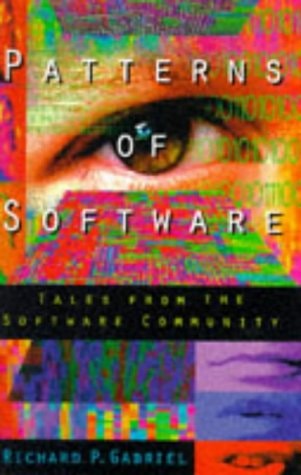
Patterns of Software: Tales from the Software Community
0
0
As an Amazon Associate and affiliate partner, Menrva Books earns from qualifying purchases. Learn more
Author Description
In our homes, our schools, and our businesses, computers play an ever-increasing role. But while most of us today can work a computer--albeit with the help of the ever-present computer software manual--we know little about what goes on inside the box and virtually nothing about software design or the world of computer programming.In Patterns of Software, the respected software pioneer and computer scientist, Richard Gabriel, gives us an informative inside look at the world of software design and computer programming and the business that surrounds them. In this wide-ranging volume, Gabriel discusses such topics as what makes a successful programming language, how the rest of the world looks at and responds to the work of computer scientists, how he first became involved in computer programming and software development, what makes a successful software business, and why his own company, Lucid, failed in 1994, ten years after its inception.Perhaps the most interesting and enlightening section of the book is Gabriel's detailed look at what he believes are the lessons that can be learned from architect Christopher Alexander, whose books--including the seminal A Pattern Language--have had a profound influence on the computer programming community. Gabriel illuminates some of Alexander's key insights--"the quality without a name," pattern languages, habitability, piecemeal growth--and reveals how these influential architectural ideas apply equally well to the construction of a computer program. Gabriel explains the concept of habitability, for example, by comparing a program to a New England farmhouse and the surrounding structures which slowly grow and are modified according to the needs and desires of the people who live and work on the farm. "Programs live and grow, and their inhabitants--the programmers--need to work with that program the way the farmer works with the homestead."Although computer scientists and software entrepreneurs will get much out of this book, th
Menrva's Summary
THE THESIS
This volume investigates the intersection of architectural theory and software engineering to determine how programming languages and development processes can better reflect human needs. Richard P. Gabriel, a respected software pioneer, draws upon his extensive experience in the industry and his tenure at his company, Lucid, to analyze the cultural and technical challenges of software creation. He argues that software development should be viewed as an organic, evolving process rather than a purely mechanical one, utilizing the philosophical framework of Christopher Alexander to propose a more habitable approach to code design.
THE SCOPE MAP
What You Will Find
- Analysis of the influence of Christopher Alexander’s architectural theories on software design.
- Case studies regarding the lifecycle and eventual failure of the software company Lucid.
- Exploration of the concept of habitability in programming environments.
- Discussion on the social and business dynamics surrounding the software development community.
THE AUTHORITY PERSPECTIVE
Experts and practitioners frequently cite this work as a foundational text for understanding the philosophical underpinnings of software design. Readers often note that while the prose is accessible, it provides a dense, reflective examination of the industry that remains relevant to modern development practices.
Page Count:
256
Publication Date:
1996-08-15
Publisher:
Oxford University Press
ISBN-10:
019510269X
ISBN-13:
9780195102697
Business
Technology
Computer programs
Software Engineering
Computer software
Programming
Computer Science
Community Tags
Similar Books