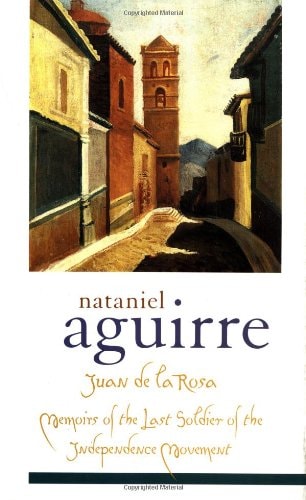
Juan de la Rosa: Memoirs of the Last Soldier of the Independence Movement
0
0
As an Amazon Associate and affiliate partner, Menrva Books earns from qualifying purchases. Learn more
Author Description
Long considered a classic in Bolivia, Juan de la Rosa tells the story of a young boy's coming of age during the violent and tumultuous years of Bolivia's struggle for independence. Indeed, in this remarkable novel, Juan's search for his personal identity functions as an allegory of Bolivia's search for its identity as a nation.Set in the early 1800s, this remarkable novel is narrated by one of the last surviving Bolivian rebels, octogenarian Juan de la Rosa. He commits his memories to paper in order to pass on that uniquely personal understanding of the past "with which serious historians never busy themselves." Juan recreates his childhood in the rebellious town of Cochabamba, and with it a large cast of full-bodied, Dickensian characters both heroic and malevolent, from Juan's wise and self-sacrificing tutor, Brother Justo, to the ruthless colonial general Goyeneche. The larger cultural dislocations brought about by Bolivia's political upheaval are echoed in those experienced by Juan, whose mother's untimely death sets off a chain of unpredictable events that propel him into the fiery crucible of the South American Independence Movement. Outraged by Juan's outspokenness against Spanish rule and his awakening political consciousness, his loyalist guardians banish him to the countryside, where he witnesses firsthand the Spaniards' violent repression and rebels' valiant resistance that crystallize both his personal destiny and that of his country.Few novels combine historical scholarship, operatic drama, comic detail, and political fervor so seamlessly. In Sergio Gabriel Waisman's fluid translation, English readers have access to Juan de la Rosa for the very first time.
Menrva's Summary
THE PULSE
An aging veteran recounts his formative years amidst the violent birth of a nation, framing his personal maturation as a mirror to Bolivia's own struggle for independence. The narrative follows Juan de la Rosa, who reflects on his childhood in Cochabamba during the early 19th century. After the death of his mother and subsequent banishment by loyalist guardians, Juan navigates a landscape defined by political upheaval and colonial repression. The story is presented as a first-person memoir, utilizing the perspective of an octogenarian to bridge the gap between intimate personal history and the broader, often overlooked, human experiences of the South American Independence Movement.
INSIDE THE PAGES
- First-person retrospective narration by an elderly protagonist
- Detailed depiction of early 19th-century Cochabamba
- Integration of historical events with fictional character arcs
- Use of Dickensian character archetypes to represent social strata
- Exploration of the intersection between personal identity and national sovereignty
- Vivid portrayal of colonial repression and revolutionary resistance
- Inclusion of a wise, self-sacrificing mentor figure
- Blending of operatic drama with political commentary
THE COLLECTIVE ECHO
Readers and critics frequently identify this work as a foundational text in Bolivian literature, noting its ability to balance intimate character development with the grand scale of historical conflict. Discussion often centers on the author's skill in weaving complex political themes into a narrative that remains grounded in the protagonist's personal growth. Many highlight the richness of the characterizations, which range from heroic figures to malevolent antagonists, providing a vivid sense of the era's social tensions. The translation is often praised for maintaining the original's fluid prose, allowing English-speaking audiences to engage with the text's unique blend of historical scholarship and dramatic storytelling.
Page Count:
368
Publication Date:
1998-11-19
Publisher:
Oxford University Press
ISBN-10:
0195113276
ISBN-13:
9780195113273
Historical Fiction
Latin American
Fiction political
War
English & College Success
English
Coming of Age
Political fiction