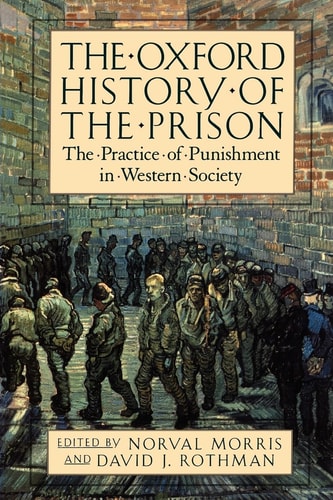
The Oxford History of the Prison: The Practice of Punishment in Western Society
0
0
As an Amazon Associate and affiliate partner, Menrva Books earns from qualifying purchases. Learn more
Author Description
The word "prison" immediately evokes stark images: forbidding walls spiked with watchtowers; inmates confined to cramped cells for hours on end; the suspicious eyes of armed guards. They seem to be the inevitable and permanent marks of confinement, as though prisons were a timeless institution stretching from medieval stone dungeons to the current era of steel boxes. But centuries of development and debate lie behind the prison as we now know it--a rich history that reveals how our ideas of crime and practices of punishment have changed over time.In The Oxford History of the Prison, a team of distinguished scholars offers a vivid account of the rise and development of this critical institution. Penalties other than incarceration were once much more common, from such bizarre death sentences as the Roman practice of drowning convicts in sacks filled with animals to a frequent reliance on the scaffold and on to forms of public shaming (such as the classic stocks of colonial America). The first decades of the nineteenth century saw the rise of the full-blown prison system--and along with it, the idea of prison reform. Alexis de Tocqueville originally came to America to write a report on its widely acclaimed prison system.The authors trace the persistent tension between the desire to punish and the hope for rehabilitation, recounting the institution's evolution from the rowdy and squalid English jails of the 1700s, in which prisoners and visitors ate and drank together; to the sober and stark nineteenth-century penitentiaries, whose inmates were forbidden to speak or even to see one another; and finally to the "big houses" of the current American prison system, in which prisoners are as overwhelmed by intense boredom as by the threat of violence. The text also provides a gripping and personal look at the social world of prisoners and their keepers over the centuries. In addition, thematic chapters explore in-depth a variety of special institutions and other important asp
Menrva's Summary
THE THESIS
This work investigates the historical evolution of the prison as a primary instrument of social control and punishment within Western society. Edited by David J. Rothman and Norval Morris, the text compiles research from a team of scholars to analyze how penal philosophies have shifted from public shaming and corporal punishment to the modern system of incarceration. The authors examine the persistent conflict between the societal impulse to punish offenders and the theoretical goal of rehabilitation, providing a comprehensive framework for understanding the development of penitentiaries.
THE SCOPE MAP
What You Will Find
- Historical analysis of penal practices ranging from the 1700s to the modern era.
- Comparative study of institutional shifts, including the transition from public shaming to solitary confinement.
- Examination of the social dynamics between inmates and prison staff across different centuries.
- Thematic exploration of special institutions and the impact of reform movements on prison architecture and policy.
THE AUTHORITY PERSPECTIVE
Experts and historians frequently cite this volume as a foundational text for understanding the development of Western penal systems. Readers often note the academic rigor and the breadth of the research, which provides a clear overview of how societal attitudes toward crime have shaped the modern prison.
Page Count:
448
Publication Date:
1997-12-18
Publisher:
Oxford University Press
ISBN-10:
0195118146
ISBN-13:
9780195118148
Non-Fiction
History
Sociology
Prisons
Criminology
Law
Justice Administration of
Community Tags
Similar Books












Reader Comments
Share Your Thoughts
No comments yet. Be the first to share your thoughts!