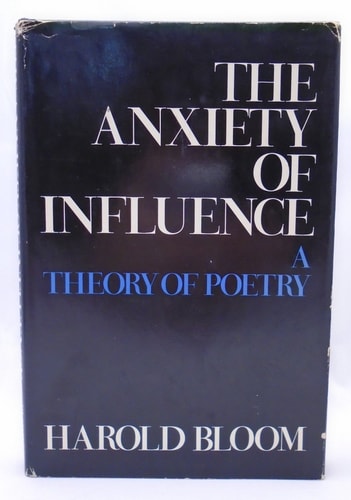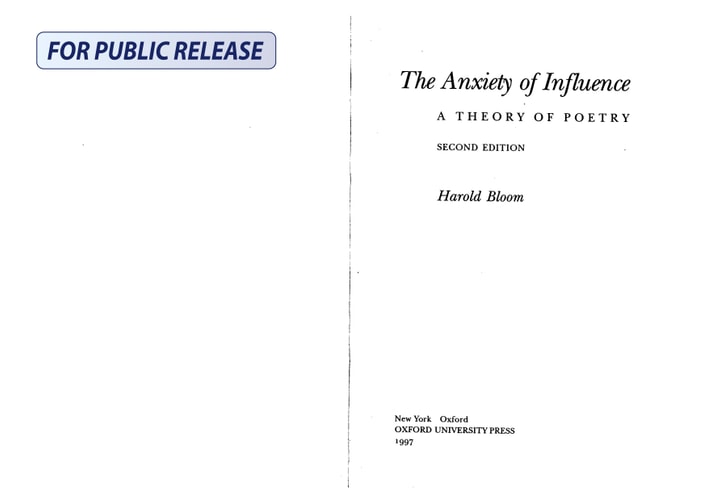
The Anxiety of Influence: A Theory of Poetry
0
0
As an Amazon Associate and affiliate partner, Menrva Books earns from qualifying purchases. Learn more
Author Description
Harold Bloom's The Anxiety of Influence has cast its own long shadow of influence since it was first published in 1973. Through an insightful study of Romantic poets, Bloom puts forth his central vision of the relations between tradition and the individual artist. Although Bloom was never the leader of any critical "camp," his argument that all literary texts are a response to those that precede them had an enormous impact on the practice of deconstruction and poststructuralist literary theory in this country. The book remains a central work of criticism for all students of literature and has sold over 17,000 copies in paperback since 1984. Written in a moving personal style, anchored by concrete examples, and memorably quotable, Bloom's book maintains that the anxiety of influence cannot be evaded--neither by poets nor by responsible readers and critics.This second edition contains a new Introduction, which explains the genesis of Bloom's thinking and the subsequent influence of the book on literary criticism of the past twenty years.criticism of the past twenty years. Here, Bloom asserts that the anxiety of influence comes out of a complex act of strong misreading, a creative interpretation he calls "poetic misprision." The influence-anxiety does not so much concern the forerunner but rather is an anxiety achieved in and by the story, novel, play, poem, or essay. In other words, without Keats's reading of Shakespeare, Milton, and Wordsworth, we could not have Keats's odes and sonnets and his two Hyperions.Given the enormous attention generated by Bloom's controversial The Western Canon, this new edition is certain to find a readymade audience among the new generation of scholars, students, and layreaders interested in the Bloom cannon.
Menrva's Summary
THE THESIS
How does the weight of literary tradition shape the creative output of individual poets? Harold Bloom, a prominent literary critic, argues that poets are locked in a psychological struggle with their predecessors, a phenomenon he terms the anxiety of influence. By examining the works of Romantic poets, Bloom posits that new artistic creation is not an act of pure inspiration but a defensive, often combative, response to the achievements of those who came before.
THE SCOPE MAP
What You Will Find
- A theoretical framework defining the concept of poetic misprision and strong misreading.
- Analysis of the psychological dynamics between successor poets and their precursors.
- Case studies focusing on the influence of figures like Milton, Shakespeare, and Wordsworth on later Romantic poets.
- An exploration of how literary history functions as a series of reactive, creative interpretations rather than a linear progression.
THE AUTHORITY PERSPECTIVE
Experts regard this work as a foundational text in poststructuralist literary theory that fundamentally altered how scholars approach the study of influence. Readers frequently note the dense, academic prose style that requires a high level of familiarity with the Western poetic canon to fully grasp the author's arguments.
Page Count:
208
Publication Date:
1997-04-10
Publisher:
Oxford University Press
ISBN-10:
0195112210
ISBN-13:
9780195112214
Poetry
Non-Fiction
Literary Criticism
Literary theory
Poetry