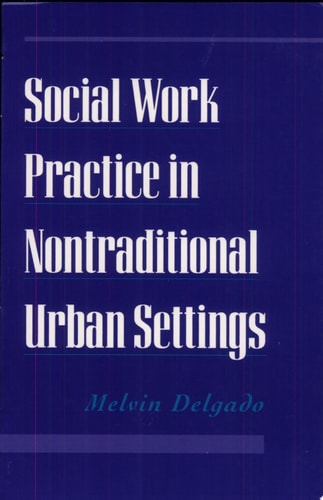
Social Work Practice in Nontraditional Urban Settings
0
0
As an Amazon Associate and affiliate partner, Menrva Books earns from qualifying purchases. Learn more
Author Description
In an era of diminishing resources, communities that have historically been served by professionals in established social service settings can no longer rely on outside resources and assistance to meet their needs. Social Work Practice in Nontraditional Urban Settings focuses on the importance of developing models that are specific to urban areas, models which help facilitate and promote conversation and advice and reduce the stigma for those seeking assistance. Delgado suggests that communities can best be served through their own, already-established recreational, social, and cultural centers. He shows professional social workers how they can use these nontraditional settings -- beauty shops, bars, and grocery stores -- to reach out to the communities they are trying to help. This allows social work service to be based on the community's own strengths, while developing the community's capacity to help itself with assistance from professionals. These institutions play influential and very active roles in providing assistance to community residents in need, offering social workers the unique opportunity to identify, engage, and plan services with communities. Often these centers are staffed by people that have a similar ethnic, socio-economic, and racial background to the rest of the community, thereby maximizing their psychological, geographical, and cultural accessibility to the community. Delgado offers a dramatic paradigm shift for social workers, showing that service delivery can take place in any setting, formal or informal. He integrates a multicultural perspective which highlights and identifies a variety of innovative methods, stressing that there is no one way of providing assistance to a community in need. Social Work Practice in Nontraditional Urban Settings is ideal for graduate courses in social work as well as for any course in human behavior and the social environment.
Menrva's Summary
THE THESIS
How can social workers effectively deliver services in urban environments where traditional institutional resources are increasingly scarce or inaccessible? Melvin Delgado, a scholar in social work and community practice, argues that professionals must pivot away from formal office-based models toward community-embedded strategies. By utilizing existing cultural and social hubs, he proposes a framework that leverages local strengths to build sustainable capacity and reduce the stigma associated with seeking professional assistance.
THE SCOPE MAP
What You Will Find
- Analysis of informal urban institutions such as beauty shops, bars, and grocery stores as service delivery points.
- Methodologies for identifying and engaging with community-based gatekeepers.
- Strategies for integrating multicultural perspectives into service planning and delivery.
- Frameworks for shifting from resource-dependent models to community-capacity building.
THE AUTHORITY PERSPECTIVE
Experts identify this work as a foundational text for understanding the intersection of community geography and social service delivery. Practitioners and students frequently note the practical utility of Delgado's approach in bridging the gap between professional social work and marginalized urban populations.
Page Count:
272
Publication Date:
1998-10-01
Publisher:
Oxford University Press
ISBN-10:
0195112482
ISBN-13:
9780195112481
Social Work
Sociology
Human services
Community Development
Urban Studies
Community Tags
Similar Books