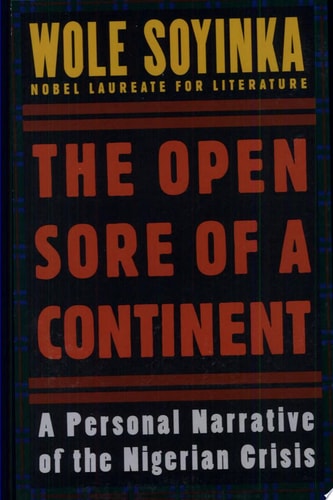
The Open Sore of a Continent: A Personal Narrative of the Nigerian Crisis
0
0
As an Amazon Associate and affiliate partner, Menrva Books earns from qualifying purchases. Learn more
Author Description
On November 10, 1995, the Nigerian military government under General Sani Abacha executed dissident writer Ken Saro-Wiwa along with eight other activists, and the international community reacted with outrage. From the Geneva based International Commission of Jurists (who called the executions a criminal act of state murder) to governments around the world (including the United States) who recalled their ambassadors, to the Commonwealth of Former British Colonies, who suspended Nigeria from the group, the response was quick, decisive, and nearly unanimous: Nigeria is an outcast in the global village. The events that led up to Saro-Wiwa's execution mark Nigeria's decline from a post-colonial success story to its current military dictatorship, and few writers have been more outspoken in decrying and lamenting this decline than Nobel Prize laureate and Nigerian exile Wole Soyinka.In The Open Sore of a Continent, Soyinka, whose own Nigerian passport was confiscated by General Abacha in 1994, explores the history and future of Nigeria in a compelling jeremiad that is as intense as it is provocative, learned, and wide-ranging. He deftly explains the shifting dramatis personae of Nigerian history and politics to westerners unfamiliar with the players and the process, tracing the growth of Nigeria as a player in the world economy, through the corrupt regime of Babangida, the civil war occasioned by the secession of Biafra under the leadership of Chief Odumegwu Ojukwu, the lameduck reign of Ernest Sonekan, and the coup led by General Sani Abacha, arguing that "a glance at the mildewed tapestry of the stubbornly unfinished nation edifice is necessary" to explain where Nigeria can go next. And, in the process of elucidating the Nigerian crisis, Soyinka opens readers to the broader questions of nationhood, identity, and the general state of African culture and politics at the end of the twentieth century.
Menrva's Summary
THE THESIS
This work investigates the systemic collapse of the Nigerian state under military dictatorship, questioning how a post-colonial nation descends into authoritarianism and state-sanctioned violence. Wole Soyinka, a Nobel laureate and prominent Nigerian exile, utilizes his personal experience as a dissident to analyze the political trajectory of his home country. He constructs a critical framework that links historical corruption to the contemporary crisis, arguing that the nation's unfinished identity remains the primary obstacle to democratic stability.
THE SCOPE MAP
What You Will Find
- Historical analysis of the Nigerian civil war and the Biafran secession movement.
- Examination of the political regimes of Babangida, Sonekan, and Sani Abacha.
- Critique of the intersection between global economic interests and domestic military rule.
- Philosophical inquiry into the nature of African nationhood and post-colonial identity.
THE AUTHORITY PERSPECTIVE
Critics and scholars recognize this text as a vital, impassioned primary source for understanding the political climate of late twentieth-century Nigeria. Readers frequently note the dense, erudite prose style that demands a foundational knowledge of the region's complex political history.
Page Count:
176
Publication Date:
1997-08-07
Publisher:
Oxford University Press
ISBN-10:
0195119215
ISBN-13:
9780195119213
Biography
Politics
History
Nigeria
Community Tags
Other Editions(2)

Similar Books


Reader Comments
Share Your Thoughts
No comments yet. Be the first to share your thoughts!