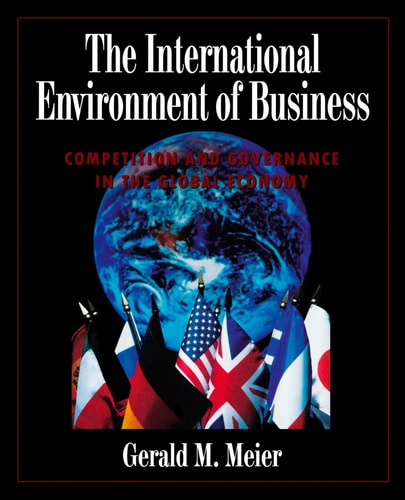
The International Environment of Business
0
0
As an Amazon Associate and affiliate partner, Menrva Books earns from qualifying purchases. Learn more
Author Description
In an innovative way, The International Environment of Business, focuses on the fundamental forces of globalization and their implications for both private management in and public management of the changing world economy. The author approaches the subject matter in a way that cuts across the traditional boundaries of business, economics, and international relations. The resulting integration provides the basis for an undertaking of international contextual analysis by managers for their practical tasks of diagnosing, predicting, and responding in their rapidly evolving international, economic, and political environment.The first five chapters establish -- in a substantial, yet concise manner -- some basic principles of international trade and finance. The emphasis is on dynamic comparative advantage, trade policy, international capital movements, and balance-of-payments policy in order to further an understanding of the conduct of international economic transactions and an evaluation of public policy. The analytical principles from these chapters are applied in a number of Policy Profiles that present real policy issues of contemporary and future importance in the world economy. A set of questions provides a basis for an extended discussion of each Policy Profile. For a more advance exposition of some analytical points, there are a number of statistical and technical appendices at the end of these chapters. The next four chapters examine problems that involve state/market relationships in a variety of countries and regions. A major structural change in the global economy is the new Europe -- the internal market integration of the European Union and the proposed movement to an Economic and Monetary Union. Also far reaching are the changes in Japan's global position, the question of "Japanomics", and Japan's transition to a new era. The newly industrialized countries (NICs) are also important actors in the global economy. But can the successful strategies of the Asia
Menrva's Summary
THE THESIS
This text investigates how the fundamental forces of globalization shape the decision-making processes for both private managers and public policymakers within the modern world economy. Gerald M. Meier, an established scholar in international economics, synthesizes principles from business, economics, and international relations to create a framework for contextual analysis. The book argues that successful management requires a deep understanding of the interplay between state policies and market dynamics in an increasingly interconnected global environment.
THE SCOPE MAP
What You Will Find
- Principles of international trade, finance, and balance-of-payments policy.
- Analysis of structural changes in the European Union and the rise of the Economic and Monetary Union.
- Examination of Japan's evolving global economic position and the concept of Japanomics.
- Application of analytical frameworks through specific Policy Profiles and discussion questions.
THE AUTHORITY PERSPECTIVE
Experts identify this work as a foundational text for understanding the intersection of macroeconomics and corporate strategy. Readers frequently note the academic density of the prose, which is balanced by practical applications and technical appendices for advanced study.
Page Count:
480
Publication Date:
1998-01-01
Publisher:
Oxford University Press
ISBN-10:
0195116410
ISBN-13:
9780195116410
Business
Economics
International relations
Finance
Management
International business
Globalization
Community Tags
Similar Books