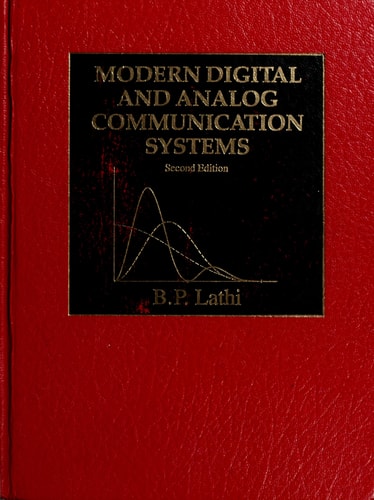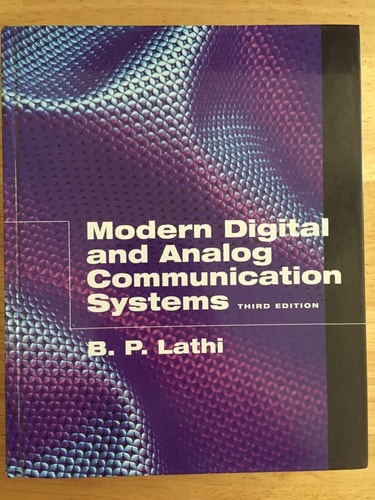
Modern Digital and Analog Communication Systems
0
0
As an Amazon Associate and affiliate partner, Menrva Books earns from qualifying purchases. Learn more
Author Description
Lathi's trademark user-friendly and highly readable text presents a complete and modern treatment of communication systems. It begins by introducing students to the basics of communication systems without using probabilistic theory. Only after a solid knowledge base--an understanding of how communication systems work--has been built are concepts requiring probability theory covered. This third edition has been thoroughly updated and revised to include expanded coverage of digital communications. New topics discussed include spread-spectrum systems, cellular communication systems, global positioning systems (GPS), and an entire chapter on emerging digital technologies (such as SONET, ISDN, BISDN, ATM, and video compression).Ideal for the first communication systems course for electrical engineers, Modern Digital and Analog Communication Systems offers students a superb pedagogical style; it consistently does an excellent job of explaining difficult concepts clearly, using prose as well as mathematics. The author makes every effort to give intuitive insights--rather than just proofs--as well as heuristic explanations of theoretical results wherever possible. Featuring lucid explanations, well-chosen examples clarifying abstract mathematical results, and excellent illustrations, this unique text is highly informative and easily accessible to students.
Menrva's Summary
THE THESIS
This text investigates the fundamental principles and modern applications of communication systems, bridging the gap between analog foundations and digital advancements. B. P. Lathi, a recognized authority in electrical engineering, utilizes a pedagogical framework that prioritizes intuitive understanding over abstract mathematical proofs. The book systematically builds a knowledge base by introducing system concepts before integrating the necessary probabilistic theory required for advanced analysis.
THE SCOPE MAP
What You Will Find
- Comprehensive coverage of both analog and digital communication signal processing.
- Detailed analysis of spread-spectrum systems, cellular networks, and global positioning systems.
- Heuristic explanations and illustrative examples designed to clarify complex mathematical results.
- Technical exploration of emerging digital technologies including SONET, ISDN, and video compression standards.
THE AUTHORITY PERSPECTIVE
Experts and educators frequently cite this work as a foundational text for undergraduate electrical engineering students due to its accessible prose and clear conceptual explanations. Readers often note that the text successfully balances rigorous mathematical theory with practical, intuitive insights into system design.
Page Count:
800
Publication Date:
1998-03-26
Publisher:
Oxford University Press
ISBN-10:
0195110099
ISBN-13:
9780195110098
textbook
Communication Theory
Electrical Engineering
Technology
Engineering
Communication Systems