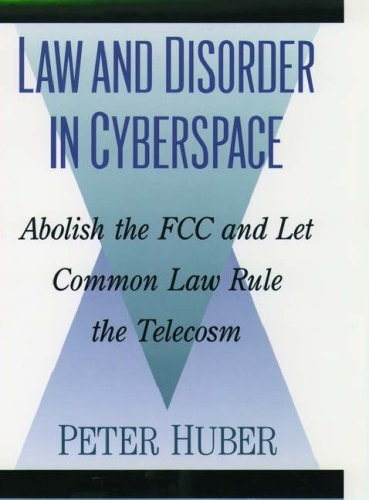
Law and Disorder in Cyberspace: Abolish the FCC and Let Common Law Rule the Telecosm
0
0
As an Amazon Associate and affiliate partner, Menrva Books earns from qualifying purchases. Learn more
Author Description
When the U.S. Congress created the Federal Radio Commission in 1927, what we now call cyberspace was just "ether." Broadcasting had only begun to carry tinny human voices and music across the fields and prairies, while Sunday afternoon phone calls to Aunt Mabel snaked through wires below, courtesy of an army of operators who switched each circuit by hand. It didn't take long, though, for the wires and airwaves to fill up with untrammeled chatter, so much so that by 1934 after complaints by the Navy that ship to shore communications had become hopelessly chaotic, and under the unproved but widely held belief that the broadcast spectrum was a finite natural resource all federal authority over electronic communications was forged into a new, powerful Federal Communications Commission. The amount of information traversing the airwaves has increased a million fold since 1927, but has the FCC changed along with the technology?The answer, according to Peter W. Huber, in Law and Disorder in Cyberspace: Abolish the FCC and Let Common Law Rule the Telecosm, is an emphatic No. In this well researched, lively, even witty polemic, Huber recounts the history of telecommunications over the last century to argue that the FCC "should have been extinguished years ago." With scarcity of communications channels no longer an issue, and the virtual elimination of distinctions between carriage and broadcast,the Commission's anachronistic laws have no basis for existence, and have in fact impeded growth and progress to the tune of billions of lost dollars. Today, the "telecosm," that complex universe of invisible communications traffic, has expanded, supplanted, and subdivided itself many times over with each new technological breakthrough. Cable television, direct broadcast satellite, cell phones, the V chip, Caller ID, personal computers, and the Internet have transformed the world. Huber argues that large bureaucratic entities like the FCC fail to adjust to such rapidly changing technol
Menrva's Summary
THE THESIS
Peter M. Huber investigates whether the Federal Communications Commission remains a relevant regulatory body in an era where technological scarcity has been replaced by an abundance of digital infrastructure. Huber, a senior fellow at the Manhattan Institute, utilizes historical analysis of telecommunications policy and economic data to argue that the FCC’s bureaucratic structure is anachronistic. He contends that the agency’s continued existence stifles innovation and that the telecommunications sector would be better served by a transition to traditional common law principles.
THE SCOPE MAP
What You Will Find
- A historical overview of the Federal Radio Commission and the subsequent formation of the FCC in 1934.
- An economic analysis of the costs associated with federal regulatory interference in the telecommunications market.
- A comparative study of technological advancements, including cable television, satellite, and the internet, against stagnant regulatory frameworks.
- A proposed legal framework advocating for the replacement of administrative oversight with common law adjudication.
THE AUTHORITY PERSPECTIVE
Experts in telecommunications law and policy often cite this work as a provocative contribution to the debate over deregulation and administrative agency reform. Readers frequently note the author's sharp, polemical style, which challenges foundational assumptions about the necessity of government oversight in the digital age.
Page Count:
288
Publication Date:
1997-10-02
Publisher:
Oxford University Press
ISBN-10:
0195116143
ISBN-13:
9780195116144
Politics
Economics
History
Law
Law And Legislation
United States
Technology
Telecommunications
Community Tags
Similar Books