Temples of the Last Pharaohs
0
0
As an Amazon Associate and affiliate partner, Menrva Books earns from qualifying purchases. Learn more
Author Description
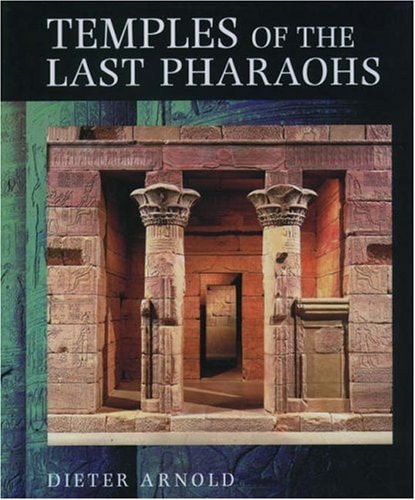
It was the great work Description de l'Egypt, published in Paris in 1809-1928, that first drew Western attention to Egyptian art and architecture. Using this work as his primary source, Dieter Arnold has reconstructed and redrawn all of the lost buildings of the Late Period--some in computer assisted images--and redrawn all other available plans. These, along with superb photographs of extant temples dating to Ptolemaic and Roman times, are included in this book on the formal and stylistic development of Egyptian temple architecture.Set against the background of the fascinating struggle of Egyptian culture with Assyrian, Greek, Persian, and Roman instrusion, the study places special emphasis on the survival of Egyptian building elements in Roman and Medieval European architecture. The book includes descriptions of building volume, stylistic evaluations, and foreign connections of the monuments as well as a detailed account of all known building activities from the end of the New Kingdom (c 716 BC) to the end of the Roman period.
Menrva's Summary
THE THESIS
This work investigates the formal and stylistic evolution of Egyptian temple architecture during the Late Period, specifically examining how these structures persisted amidst foreign political intrusion. Dieter Arnold, a noted scholar in the field of Egyptian architecture, utilizes the foundational data from the 19th-century Description de l'Egypte as a primary source. By integrating modern computer-assisted reconstructions with archival plans and contemporary photography, the author provides a comprehensive analysis of building activities from the end of the New Kingdom through the Roman era. The study argues that Egyptian architectural elements maintained a distinct continuity even as the culture navigated the pressures of Assyrian, Greek, Persian, and Roman occupation.
THE SCOPE MAP
What You Will Find
- Detailed architectural analysis of temples from the Late Period (c. 716 BC) to the Roman era.
- Computer-assisted reconstructions and redrawn plans of lost or damaged structures.
- Comparative study of Egyptian building elements and their influence on Roman and Medieval European architecture.
- Historical context regarding the cultural impact of foreign political intrusions on indigenous building practices.
THE AUTHORITY PERSPECTIVE
Experts recognize this volume as a definitive reference for the study of late-stage Egyptian temple design and construction techniques. Readers frequently note the technical density of the prose, which serves as a rigorous resource for students and professionals in archaeology and architectural history.
Page Count:
384
Publication Date:
1999-12-02
Publisher:
Oxford University Press
ISBN-10:
0195126335
ISBN-13:
9780195126334
History
Architecture
Art History
Ancient Egypt
Temples
Archaeology
Community Tags
Similar Books