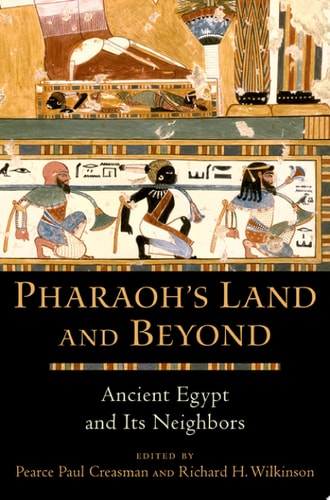
Pharaoh's Land and Beyond: Ancient Egypt and Its Neighbors
0
0
As an Amazon Associate and affiliate partner, Menrva Books earns from qualifying purchases. Learn more
Author Description
The concept of pharaonic Egypt as a unified, homogeneous, and isolated cultural entity is misleading. Ancient Egypt was a rich tapestry of social, religious, technological, and economic interconnections among numerous cultures from disparate lands. In fifteen chapters divided into five thematic groups, Pharaoh's Land and Beyond uniquely examines Egypt's relationship with its wider world. The first section details the geographical contexts of interconnections by examining ancient Egyptian exploration, maritime routes, and overland passages. In the next section, chapters address the human principals of association: peoples, with the attendant difficulties of differentiating ethnic identities from the record; diplomatic actors, with their complex balances and presentations of power; and the military, with its evolving role in pharaonic expansion. Natural events, from droughts and floods to illness and epidemics, also played significant roles in this ancient world, as examined in the third section. The final two sections explore the physical manifestations of interconnections between pharaonic Egypt and its neighbors, first in the form of material objects and second, in the powerful exchange of ideas. Whether through diffusion and borrowing of knowledge and technology, through the flow of words by script and literature, or through exchanges in the religious sphere, the pharaonic Egypt that we know today was constantly changing--and changing the cultures around it. This illustrious work represents the first synthesis of these cultural relationships, unbounded by time, geography, or mode.
Menrva's Summary
THE THESIS
This work investigates the extent to which ancient Egypt functioned as an interconnected node within a broader network of cultures rather than an isolated civilization. Pearce Paul Creasman and Richard H. Wilkinson, both established scholars in Egyptology, utilize archaeological evidence and historical records to challenge the traditional view of Egyptian homogeneity. They present a framework that categorizes these interconnections into geographical, human, environmental, material, and intellectual spheres to demonstrate the constant exchange of power, technology, and ideas.
THE SCOPE MAP
What You Will Find
- Analysis of maritime and overland trade routes
- Examination of diplomatic and military interactions with neighboring states
- Studies on the impact of environmental factors like drought and disease
- Discussion on the diffusion of material culture and linguistic scripts
Scope Limits
- The text does not provide a chronological narrative of Egyptian history
- It does not focus on internal domestic politics outside of their relation to foreign influence
THE AUTHORITY PERSPECTIVE
Experts recognize this volume as a significant synthesis of cross-cultural interactions in the ancient world. Readers frequently note the academic rigor of the chapters while appreciating the thematic organization that makes complex archaeological data accessible to students and researchers alike.
Page Count:
367
Publication Date:
2017-01-01
Publisher:
Oxford University Press
ISBN-10:
0190229098
ISBN-13:
9780190229092
History
Religion
English
History - Ancient
English & College Success
Ancient Egypt
Egypt - History
Ancient History
International relations
Anthropology
Archaeology
Community Tags
Similar Books